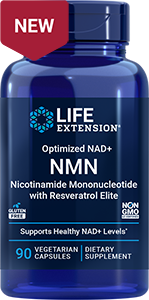
NMN vs. NR: Everything You Need to Know About NAD Supplements
Published: November 2023 | Updated: May 2026

At a Glance
- NAD+ is a coenzyme that is required for hundreds of crucial cellular processes.
- Supporting healthy NAD+ levels is a smart strategy for healthy aging.
- NR and NMN are both precursors your body can use to build NAD+ and support healthy levels.
- Both NR and NMN have been shown to raise NAD+ levels and promote healthy aging.
NAD is a coenzyme that's absolutely vital to generating cellular energy and managing cellular metabolism. It is needed throughout your body. Unfortunately, levels tend to decline with age. That's why you'll hear a lot of buzz in the health and wellness community (even from celebrity A-listers!) about taking "NAD supplements."
This is a bit of a misnomer, though; we can't take NAD directly because it's not well absorbed and can't pass into cells to be used. Instead, we opt for precursor supplements like NR or NMN, both of which can be used by the body to build NAD+. (NAD, NAD+ and NADH are all the same coenzyme; NAD+ means the molecule is oxidized while NADH is reduced.)
So what’s the difference between NMN and NR, and what exactly are they? Let’s discuss how each precursor works and which you should consider for your healthy aging stack.

What is NMN (nicotinamide mononucleotide)?

Nicotinamide mononucleotide (NMN) is one of the most popular ways to support NAD+ levels. It is a precursor, a molecule that can be used to build another molecule, in this case, NAD+. And, you can take NMN supplements.
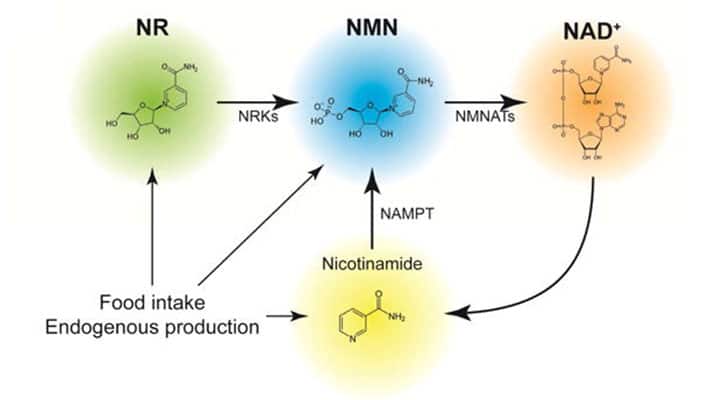
NMN is converted to NAD+ inside cells by specialized enzymes. Since there is only one step to convert NMN to NAD+ inside cells, NMN is a direct precursor.
But first, NMN has to get inside the cell, and there are a few ways that can happen:
- Research suggests that NMN outside the cell is first converted to NR to pass through the cell membrane, then it is converted back to NMN (which is then converted to NAD+).
- NMN can also be metabolized by enzymes from gut microbes to a form like vitamin B3 (niacin) that can pass the cell membrane.
- Plus, here is a bit of evolving science: In 2019, researchers found a unique cell transporter called Slc12a8. The researchers believe this is an NMN-specific transporter that allows NMN to pass directly into cells without requiring any changes to its structure first. However, this has not been demonstrated in humans.
Regardless of whether there is a specific transporter for NMN, though, we know that if NMN is taken orally, NAD+ levels rise. And that supports the production of cellular energy and healthy aging.
What is NR (nicotinamide riboside)?

Nicotinamide riboside, or NR, is another precursor the body can use to build NAD+. It is well-studied for raising NAD+ levels when taken orally. In fact, nicotinamide riboside may be the most well-studied precursor for raising NAD+ levels.
NR was first discovered in 2004 and became available as a dietary supplement starting in 2013. Since then, dozens of clinical studies have been published with this ingredient.
When you consume NR orally:
- It is directly transported inside cells by cell membrane proteins, then converted to NMN by enzymes. Once in NMN form, different enzymes further convert it NAD+.
- Alternatively, it can also be metabolized by gut enzymes to form niacin before entering the cell. Niacin then undergoes a three-step process to become NAD+.
NR is not a direct structural precursor to NAD+ like NMN. But its easy passage through cell membranes means it is still efficiently converted to NAD+ when taken orally, which raises blood NAD+ levels to support healthy cellular energy and healthy aging.
NMN and NR as NAD precursors: Which is better?
Both NR and NMN can raise NAD+ levels.
- NMN is closer structurally to NAD+ (it's a direct precursor). It is still unclear whether it passes directly through cell membranes. However, when taken orally, NMN reliably raises NAD+ levels.
- NR is not a direct precursor (it must be converted to NMN before it becomes NAD+). However, it passes easily through cell membranes and when taken orally, NR reliably raises NAD+ levels.
Which one is better to take comes down to personal preference. NR has been consistently available as a dietary supplement for over 10 years, while NMN could not be sold as a dietary supplement for a few years because of regulatory guidelines. As such, NR is more widely established. On the other hand, NMN is generally less expensive.
| NAD+ precursor | NMN | NR |
|---|---|---|
| Health Benefits |
|
|
| Bioavailability | Orally bioavailable; raises blood NAD+ | Orally bioavailable; raises blood NAD+ |
| How it converts to NAD+ |
3 possible pathways:
|
2 possible pathways:
|
| Research Findings | Raises blood NAD+ levels | Raises blood NAD+ levels |
| Cost | Less expensive | More expensive |

Explore Our Best Anti-Aging & Longevity Supplements
Both NR and NMN supplements are well-tolerated, effective at raising NAD+ levels, and available as dietary supplements in the United States.
NMN vs. NR research comparison
Both NMN and NR have been studied in multiple clinical trials, and both have been shown to increase blood NAD+ levels to a similar degree.
Many clinical studies have been conducted, and one thing is clear: Both reliably raise NAD+ levels in humans when taken orally. And most recent research suggests that at comparable doses, there isn’t much of a difference.
Because of NR’s longer history as a dietary supplement, there are more human trials for this nutrient. However, NMN has been gaining popularity, and this gap is getting smaller. So your decision between precursors is a personal choice with no downside.
"Because NAD+ is so widely needed throughout your body, targeted supplements to increase levels are a smart addition to your healthy aging routine."
Benefits of increasing NAD+ support
Your body requires NAD+ for hundreds of critical cellular processes, including cellular energy (ATP) production and cellular metabolism. Your cells need NAD+ to survive, which is why it's found in every living cell in your body.
But NAD+ tends to decline with age. Age-related cellular changes lead to NAD+ being increasingly consumed. Some studies suggest that NAD+ drops by up to 50% by middle age.
Boosting NAD+ has gained the interest of researchers and wellness advocates alike, and it’s no wonder. Healthy NAD+ levels are required for healthy aging. Adding an NAD+ precursor to your supplement stack:
- Supports healthy levels of the coenzyme NAD+
- Encourages production of cellular energy in the body
- Promotes healthy aging at the cellular level
Because NAD+ is so widely needed throughout your body, targeted supplements to increase levels are a smart addition to your healthy aging routine.
NAD supplements can also be taken to the next level by pairing them with other healthy aging nutrients like resveratrol, which protects against oxidative stress and supports cardiovascular, brain, and metabolic health. A product that combines these nutrients can help you get an edge up on your healthy aging routine without needing to add multiple pills.
Can NMN and NR be taken together safely?
For most healthy adults, both NR and NMN have been shown to be safe and well-tolerated. However, these nutrients haven’t been studied together, so their combined safety and efficacy is unknown. There is no evidence that it would be better than using one supplement alone.
Are NMN and NR the only ways to boost NAD+ levels?
You can boost NAD+ levels in lots of ways. Other precursor molecules like niacin and niacinamide (both forms of vitamin B3) may raise NAD+ levels, albeit not as effectively as NR or NMN.
Niacin
requires a three-step process to become NAD+. High doses cause flushing.Nicotinamide
does not cause flushing, but it first must be converted to NMN, and research suggests it does not raise NAD+ levels as effectively as NR or NMN.
You may have noticed that all these precursors (and NAD for that matter) all have similar names, which leads to some confusion. They have similar names because they are all built from similar molecular structures. Most of the NAD in the body is synthesized from these precursor molecules using various cellular pathways.
In addition to precursors, your lifestyle choices can boost NAD+. As usual, diet and exercise are the top two factors. Exercise may help increase muscle NAD+ and improve mitochondrial function, while caloric restriction may also improve NAD+/NADH levels. Other lifestyle factors, such as getting optimal sleep and avoiding alcohol and cigarettes, can also help.
There is some preliminary evidence that saunas and cold plunges can raise NAD+ as well, but these tools may not be for everyone, and research is still in very early stages.
Trying to decide which supplements are best for your healthy aging journey? Our health needs quiz can give you a recommendation tailored to your lifestyle.
Key Takeaways
- Healthy NAD+ levels are key when it comes to many aging-related goals.
- Precursor molecules like NMN and NR help increase NAD+ levels and ensure your cells have enough.
- NMN and NR appear to raise NAD+ levels to a comparable degree in clinical studies.
- The decision between these precursors is a personal choice with no downside.

References
- Alegre GFS, Pastore GM. "NAD+ Precursors Nicotinamide Mononucleotide (NMN) and Nicotinamide Riboside (NR): Potential Dietary Contribution to Health." Curr Nutr Rep. September 2023. https://www.ncbi.nlm.nih.gov/pmc/articles/PMC10240123/
- Bloomer RJ, et al. "Use of the Dietary Supplements NR and NMN to Increase Nicotinamide Adenine Dinucleotide, Impact Mitochondrial Function, and Improve Metabolic Health." November 2025. https://www.mdpi.com/3042-5158/1/2/9
- Christen S, et al. "The differential impact of three different NAD+ boosters on circulatory NAD and microbial metabolism in humans." Nat Metab. January 2026. https://www.nature.com/articles/s42255-025-01421-8
- Conze D, et al. "Safety and Metabolism of Long-term Administration of NIAGEN (Nicotinamide Riboside Chloride) in a Randomized, Double-Blind, Placebo-controlled Clinical Trial of Healthy Overweight Adults." Scientific Reports. July 2019. https://www.nature.com/articles/s41598-019-46120-z
- Grozio A, et al. "Slc12a8 is a nicotinamide mononucleotide transporter." Nat Metab. January 2019. https://www.ncbi.nlm.nih.gov/pmc/articles/PMC6530925/
- Igarashi M, et al. "Chronic nicotinamide mononucleotide supplementation elevates blood nicotinamide adenine dinucleotide levels and alters muscle function in healthy older men." NPJ Aging. May 2022. https://pubmed.ncbi.nlm.nih.gov/35927255/
- Ito TK, et al. "A single oral supplementation of nicotinamide within the daily tolerable upper level increases blood NAD+ levels in healthy subjects." Translational Medicine of Aging. 2021. https://www.sciencedirect.com/science/article/pii/S2468501121000055
- Li Q, et al. "Improving Mitochondrial Function in Skeletal Muscle Contributes to the Amelioration of Insulin Resistance by Nicotinamide Riboside." Int J Mol Sci. June 2023. https://www.mdpi.com/1422-0067/24/12/10015
- Morifuji M, et al. "Ingestion of β-nicotinamide mononucleotide increased blood NAD levels, maintained walking speed, and improved sleep quality in older adults in a double-blind randomized, placebo-controlled study." Geroscience. October 2024. https://pubmed.ncbi.nlm.nih.gov/38789831/
- Palmer RD, et al. "Precursor comparisons for the upregulation of nicotinamide adenine dinucleotide. Novel approaches for better aging." Aging Med (Milton). August 2021. https://www.ncbi.nlm.nih.gov/pmc/articles/PMC8444956/
- Pirinen E, et al. "Niacin Cures Systemic NAD+ Deficiency and Improves Muscle Performance in Adult-Onset Mitochondrial Myopathy." Cell. June 2020. https://www.cell.com/cell-metabolism/pdfExtended/S1550-4131(20)30190-X
- Walzik D, et al. "Tissue-specific effects of exercise as NAD+-boosting strategy: Current knowledge and future perspectives." Acta Physiol (Oxf). March 2023. https://pubmed.ncbi.nlm.nih.gov/36599416/

Always be in the know!
Access the latest deals, wellness news, expert health tips & more!
Popular Supplement