Nattokinase Benefits: Why Should You Take It?
Published: February 2024 | Updated: November 2025
At a Glance
- The health benefits of natto, a sticky Japanese dish of fermented soybeans, are typically attributed to the nattokinase enzyme.
- Nattokinase has been clinically studied for its ability to support already-healthy blood pressure and heart health.
- Nattokinase also supports the body's natural clotting process and encourages blood flow.
Life moves fast, but sometimes we are more sedentary than we would like. Unfortunately, this throws a wrench not just into our weight management strategies, but also our heart health.
Dietary choices also matter, and some of the most heart-healthy foods are not exactly American crowd-pleasers. One example? The sticky and stringy Japanese dish natto.
Even if you happen to be a big fan of fermented soybeans, it isn't easy to find on most menus, even at your local Japanese restaurant (which is more likely to serve sushi and teppanyaki).
But that doesn't mean we can't get the health benefits of natto through other means. A nattokinase supplement helps us get the best of natto and encourages cardiovascular health.
What is nattokinase?
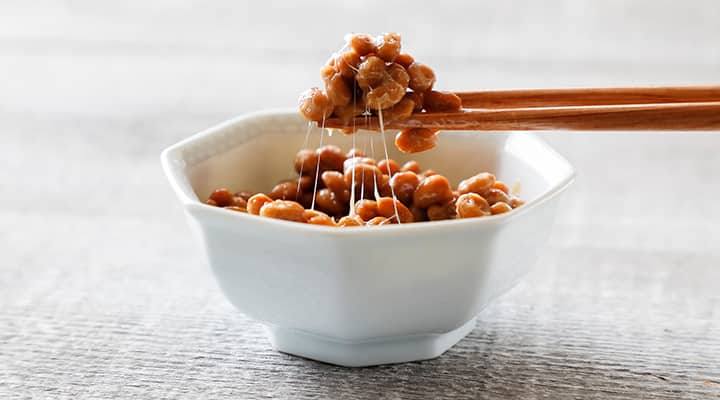
Nattokinase is an enzyme made by the bacteria Bacillus subtilis during the production of natto, a traditional Japanese dish of gooey fermented soybeans. Like other fermented foods—such as yogurt, sauerkraut, kefir, and kimchi—natto provides an array of health benefits, mostly attributed to the beneficial microbes that ferment these foods. What makes natto different from these other foods is that some of its most important health benefits come from compounds produced during fermentation: namely, the creation of nattokinase.
5 science-backed benefits of nattokinase and natto
A meta-analysis and systematic review of clinical trials identified that nattokinase is effective at supporting cardiovascular health. Let's dig into the multiple ways that natto and the beneficial enzyme it contains, nattokinase, are good for heart health—and beyond!

- Supports healthy circulation and blood flow. Natto may be particularly beneficial to cardiac function. Studies suggest that nattokinase encourages healthy blood flow and circulation, which are cornerstones of cardiovascular health.
- May help maintain already-healthy blood pressure. Studies have found that nattokinase (at a dosage of 100 mg or 2,000 FU daily) can help support already-healthy blood pressure.
- Provides a source of vitamin K2 as MK-7. Natto is one of the best food sources of vitamin K2 in the form of menaquinone-7 (MK-7), which is the form typically found in fermented foods. Vitamin K2 is important for maintaining overall health, with particular benefits for bone, heart and arterial health.
- Part of a healthy diet. The Japanese diet has long been associated with healthy aging and a longer healthspan. This way of eating incorporates nutrient-dense foods like seaweed, natto and fish, which have been studied for many health benefits. Research shows that natto intake can support healthy aging and various aspects of heart health.
- Supports gut health. Natto is a fermented soybean product, so consuming natto directly can help give your gut those healthy, helpful beneficial bacteria it needs. Natto also provides fiber, which is good for staying satiated (and snack-free!), among other health benefits of fiber.
Natto vs. nattokinase supplements: What's the difference?
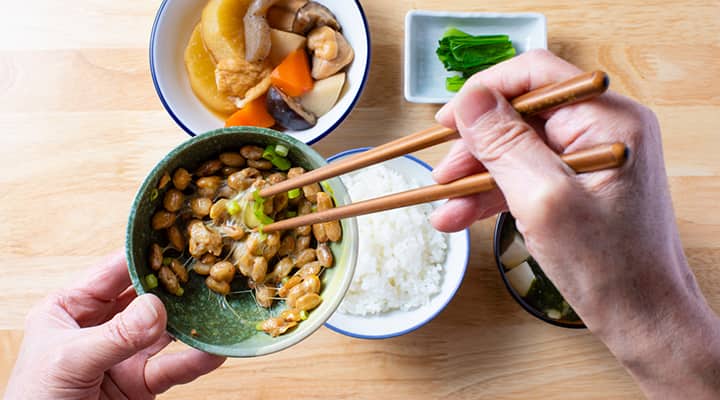
Made from fermented soybeans, natto is a food that's hard to find and not popular in the American diet. While natto is chock-full of minerals and vitamins, particularly vitamin K2, many of its health benefits are attributed to nattokinase, the enzyme that gives natto many of its health benefits. Nattokinase has been clinically studied for its ability to support already-healthy blood pressure and heart health. It can be taken in supplement form.
You can get the heart-health benefits of nattokinase from eating natto or taking a nattokinase supplement. For benefits such as fiber, you'll want the dietary source. But supplementing is likely a more practical approach for most, given that natto is not a staple of the American diet—plus, the amount of nattokinase in a supplement is standardized, so you're always getting the same amount.
Here's a breakdown of the benefits of each.
| Benefit | Natto | Nattokinase supplements |
|---|---|---|
| Circulation and blood flow | ✅ | ✅ |
| Already-healthy blood pressure support | ✅ | ✅ |
| Vitamin K2 source | ✅ | ❌ |
| Part of a healthy diet | ✅ | ❌ |
| Contains fiber | ✅ | ❌ |
| Standardized, clinically studied dosage of nattokinase | ❌ | ✅ |
| Easy to find in the United States | ❌ | ✅ |
| Is practical for daily consumption | ❌ | ✅ |
| A good option for picky eaters | ❌ | ✅ |
How to take nattokinase for maximum effect
The best way to get consistent intake of this powerful enzyme is a high-quality nattokinase supplement. While we can simply eat natto to obtain nattokinase, natto is often described as an acquired taste. Plus, you would need to commit to eating it daily.

Nattokinase can be extracted, purified and packaged into a dietary supplement that provides a convenient way to get its blood pressure support and heart-healthy effects.
Stick to a studied nattokinase dosage
: A clinically studied dose is 100 mg daily, or 2,000 fibrinolytic units (FU), which is equivalent. (Be aware: You would need to eat about ¼ cup of natto to get the amount of nattokinase found in one 100 mg capsule.)Follow the product label
: Many nattokinase supplements are best taken on an empty stomach. Always follow the product label. If the label does not specify, choose a time that works best for your daily routine.Be consistent
: Some studies find nattokinase supplement benefits in the shorter term, whereas others find it takes longer to see the effects of supplementation. Ideally, a nattokinase supplement would be taken long-term to maximize its benefits.Pair it with French maritime pine bark extract
: Clinical studies have shown that French maritime pine bark extract, sometimes called pycnogenol, helps support healthy blood flow. Taken together, these two make a complete cardiovascular couple.
Pro tip: When designing your heart health routine, don't forget to include foods that help support your body's nitric oxide production. Nitric oxide is another superstar in supporting blood flow and a healthy cardiovascular system.

Explore Our Blood Pressure Support Supplements
How does nattokinase work in the body?
Nattokinase breaks down proteins in the body, notably a protein called fibrin, which plays a role in the natural blood clotting process. (Advanced science vocab lesson here: breaking down proteins makes this enzyme proteolytic, while its breakdown of fibrin makes it fibrinolytic.) That's not the only way it breaks down fibrin: nattokinase also helps support a protease (tissue plasminogen activator) that leads to even more fibrin breakdown. This explains why nattokinase has been investigated for its beneficial effects on cardiovascular outcomes, blood flow and circulation.
More science here (to help you win that trivia game): Despite its name, nattokinase is not actually a kinase enzyme. (It is commonly mispronounced, but the "kinase" in nattokinase is pronounced "kuh-nays" vs. "kai-nays.") Additionally, because it is derived from fermented soybeans, it is an enzyme, not a soy isoflavone.
Is nattokinase safe to take daily?

Yes, and consistency is key. By taking it every day, you can provide your body with a constant intake to give the ingredient time to build up and take effect in your body.
As a cardinal rule of supplements, always be sure to follow the directions on the product label. The dosage and directions are determined by what was used in clinical studies.
Also, don't forget to speak with your doctor before adding any new supplements to your routine, especially if you are on a vitamin K antagonist.
How long does it take for nattokinase to work?
Some studies find nattokinase supplement benefits in the shorter term, whereas others find it takes longer to see the effects of supplementation.
What is the best time of day to take nattokinase?
The best time to take nattokinase is according to the directions on the product label and at the time that works for you because, again, consistency is key. It is best to do whatever works with your schedule and helps you take it every day. A good idea is to take it at the same time as your other supplements, so you don't forget any of them.
Can you eat nattokinase?
Yes, you can get nattokinase from natto itself, but you're going to be getting it at a much lower dose. You would need to eat about ¼ cup of natto to get the amount of nattokinase found in one 100 mg capsule.
Not sure where to start with targeted cardiovascular nutrition? Take our health needs quiz to get personalized recommendations to guide your supplement journey.
At a Glance
- Nattokinase, an enzyme made during the production of traditional Japanese natto, can help maintain already-healthy blood flow.
- Natto and nattokinase have been studied to support healthy aging and various aspects of heart health.
- Nattokinase is safe to take daily according to the directions on the product label, but always speak to a healthcare provider first.

References
- Belcaro G. "A Clinical Comparison of Pycnogenol, Antistax, and Stocking in Chronic Venous Insufficiency." Int J Angiol. December 2015. https://pubmed.ncbi.nlm.nih.gov/26648668/
- Belcaro G, et al. "Postpartum Varicose Veins: Supplementation with Pycnogenol or Elastic Compression-A 12-Month Follow-Up." Int J Angiol. March 2017. https://pubmed.ncbi.nlm.nih.gov/28255210/
- Jensen GS, et al. "Consumption of nattokinase is associated with reduced blood pressure and von Willebrand factor, a cardiovascular risk marker: results from a randomized, double-blind, placebo-controlled, multicenter North American clinical trial." Integr Blood Press Control. October 2016. https://pubmed.ncbi.nlm.nih.gov/27785095/
- Kim JY, et al. "Effects of nattokinase on blood pressure: a randomized, controlled trial." Hypertens Res. August 2008. https://pubmed.ncbi.nlm.nih.gov/18971533/
- Li X, et al. "Nattokinase Supplementation and Cardiovascular Risk Factors: A Systematic Review and Meta-Analysis of Randomized Controlled Trials." Rev Cardiovasc Med. August 2023. https://pubmed.ncbi.nlm.nih.gov/39076715/
- Nagata C, et al. "Dietary soy and natto intake and cardiovascular disease mortality in Japanese adults: the Takayama study." Am J Clin Nutr. February 2017. https://pubmed.ncbi.nlm.nih.gov/27927636/
- Tsukamoto Y, et al. "Intake of fermented soybean (natto) increases circulating vitamin K2 (menaquinone-7) and gamma-carboxylated osteocalcin concentration in normal individuals." J Bone Miner Metab. 2000. https://pubmed.ncbi.nlm.nih.gov/10874601/
- Wang C, et al. "Natto: A medicinal and edible food with health function." Chin Herb Med. May 2023. https://pubmed.ncbi.nlm.nih.gov/37538862/
- Wei C, et al. "Research Progress of Nattokinase in Reducing Blood Lipid." Nutrients. May 2025. https://pubmed.ncbi.nlm.nih.gov/40507053/
- "Vitamin K." National Institutes of Health. March 2021. https://ods.od.nih.gov/factsheets/VitaminK-HealthProfessional/
- "What is Nattokinase?" Japan NattoKinase Association. http://j-nattokinase.org/en/jnka_nattou_01.html

Always be in the know!
Access the latest deals, wellness news, expert health tips & more!
Heart Health Favorite