15 Foods with Melatonin That May Help You Sleep Better
Published: November 2022 | Updated: January 2026
At a Glance
- Food sources of melatonin include eggs, nuts, and mushrooms.
- The melatonin in foods likely won't be enough to impact sleep, making supplementation a good choice for many people.
- Proper sleep hygiene is crucial for getting enough high-quality sleep.
It can be a struggle to get enough quality sleep, leaving us feeling fatigued and less than our best the next day. And for better or worse, what you consume can impact how much shut-eye you get each night, which is why many people seek help from supplements like melatonin.
Known as the "sleep hormone" and produced naturally in the body by the pineal gland, melatonin is also found in foods, ranging from animal-based products like eggs and milk to fruits, vegetables and legumes.
And while these foods also offer many other nutrients that benefit your overall health, the amount of melatonin in food is generally extremely low—so low that you'd need to eat superhuman amounts to get a sleep-supporting dose of melatonin. So, if you're looking for healthy sleep, complementing your healthy diet with a melatonin supplement is a good bet.
15 foods that contain melatonin

Below is a list of foods that contain higher-than-average levels of melatonin. But before we go any further, an important caveat: while there's more melatonin in these foods than in others that didn't make this list, it's still pretty low. You would need to consume numerous servings of each to get enough melatonin to impact your sleep, as they contain a small fraction of what you'll find in a melatonin supplement.
That being said, the nutritional profile of most of these foods is pretty stellar, making them worthwhile additions to your diet, even if they don't contain much in the way of "vitamin ZZZs."
1. Eggs
Good news for breakfast lovers: One egg contains roughly 330 nanograms (ng) of melatonin. (For the purpose of comparison, a lower-dose melatonin supplement contains 300 micrograms—a thousand-fold difference—per capsule. We told you there wasn't much in food!)
Scramble them, poach them, or hard-boil them for an easy snack. Dress them up with vegetables like spinach, peppers or onions. Who's craving an omelet for dinner?
2. Salmon and other fatty fish
A serving of cooked salmon that's around 5.3 oz. contains about 555 ng of melatonin. Consider that salmon is also packed with healthy fats, such as omega-3s, and protein; this fish should definitely make it into your weekly dinner rotation. Mackerel, sardines, and anchovies are other fatty fish options that contain melatonin. Sardines, in particular, are experiencing a renaissance. Eat them straight from the can, put them on crackers or toast, or add them to salad or pasta.
3. Nuts
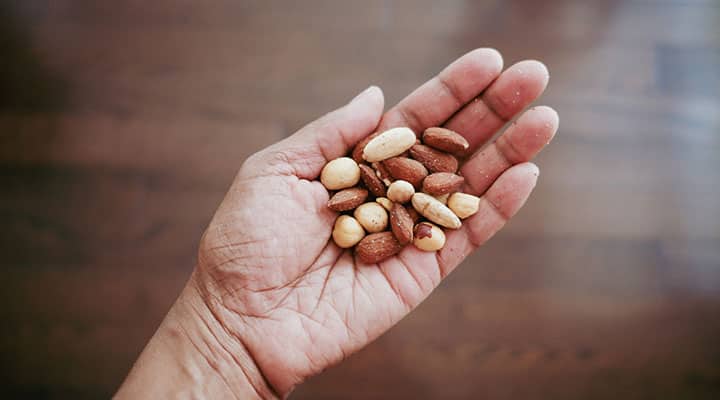
They're more than just a crunchy, delicious snack: nuts are a great melatonin food, too. Depending on the variety, a serving of walnuts (approximately 1 oz.) can contain around 105 ng of melatonin. If you eat an ounce of pistachios (again, depending on the variety), you can get about 360 ng of melatonin.
Nuts, while nutrient-packed, are a higher-calorie food—and it's easy to snack on them mindlessly. (Been there, done that!) So, just be mindful of your portion sizes if weight management is on your to-do list.
4. Sprouted legumes
A serving of sprouted lentils is roughly 100 grams, which gets you about 0.102 mg of melatonin.
Lentils are jam-packed with nutrients. You can eat them hot or cold and in endless dishes. Add them to soup, salad, or cook them with a little onion and garlic for a tasty carb. (They're a good source of protein, too.)
5. Seeds
Pumpkin seeds aren't only for October. Eat them year-round, and a serving of 30 g will add about 15 ng of melatonin to your diet.
Snack on pumpkin seeds plain or add them to your salad for a crunchy, nutrient-dense punch.
6. Cow's milk

Approximately one cup of cow's milk gets you 3.5 ng of melatonin. Try a mug of golden milk before bedtime for a tasty and turmeric-packed treat.
7. Oats
Oats aren't just for breakfast! In a 40 g serving, you can get around 3,600 ng of melatonin. Oats are incredibly versatile, so if eating them plain isn't your jam, we're willing to bet you can find an oatmeal recipe out there that you love. You can also soak them overnight and eat them the next morning, when they're cold and refreshing.
Some people even blend them into their smoothies for added thickness.
8. Corn
The numbers vary widely depending on the cultivated variety, but in a serving of cooked corn (around half a cup, or 100 g), you can expect to get up to 280 ng of melatonin.
Eating it off the cob, from the can, or frozen is always an option. You can also add corn to soups, salads and dips.
9. Rice
Again, the numbers vary, but a 150 g serving of basmati rice contains around 5,700 ng of melatonin and is a great source of healthy carbohydrates.
10. Tomatoes
Tomatoes can contain up to 10.5 ng in a 150 g serving. If you're not the biggest tomato fan, consider cooking and blending them into soup.
11. Bananas
One banana may contain up to 204 ng of melatonin. This is probably one of the most versatile fruits, thanks to its mild flavor. Aside from snacking on them plain, you can incorporate them into your toast, oatmeal, smoothies or yogurt. (For smoothies, try freezing them first.)
12. Grapes
On average, you'll get about 11.7 ng of melatonin per grape. We love adding grapes to Greek yogurt, salad, and even salads and sandwiches! (If you haven't added sliced grapes to a turkey sandwich, you haven't lived.)
13. Mushrooms

There are all sorts of mushrooms, but in particular, the appropriately named Lactarius deliciosus (aka delicious "milk cap" mushroom) gives you approximately 1.29 mg of melatonin in a 100 g serving!
This is, by far, the most you can get from all of the melatonin foods on this list.
Another option (and a more common variety of mushroom that you can easily find) is Cantharellus cibarius (golden chantarelle), which has about 1,400 ng of melatonin per gram of mushroom—still one of the best foods for sleep on this list.
14. Tart cherries
When people talk about consuming tart cherries for their melatonin production, they're usually talking about Montmorency cherries. These get you about 13.5 ng of melatonin per gram of cherries.
Despite the reputation tart cherries have for supporting sleep, and while there is some preliminary evidence that the fruit and its juice may help your slumber, ironically, it's highly likely that this isn't actually due to the melatonin content. But these fruits are very high in antioxidants and when standardized in supplement form, have been studied for their benefits to muscle health and post-exercise recovery.
15. Kiwi
Kiwis are similar to cherries in that they may support sleep, but probably not due to the melatonin content, as they contain only 0.02 ng per gram of kiwi.
However, even if they don't have a notable impact on your sleep, they contain plenty of other nutrients that your body will love.

Explore Our Best Sleep Supplements
Melatonin supplements vs. foods with melatonin

A healthy diet does support healthy sleep, but it's probably not the melatonin content that is responsible for the sleep benefits. Like we said in the beginning, you'd need to eat a lot of these foods to consume any significant amount of melatonin.
Additionally, melatonin supplements are standardized so that every capsule, gummy or drop will have the exact same amount of melatonin. But the numbers provided above should be taken with a large grain of salt; the melatonin levels in food vary significantly due to factors such as farming techniques and sunlight exposure.
How can I increase melatonin levels naturally?
Aside from adjusting your diet to get more melatonin, there are other ways to practice good sleep hygiene to promote healthy melatonin production:
| Sleep Hygiene Habit | Why |
|---|---|
| Avoid screens and blue light before bedtime | Exposure to blue light is bad for the body’s melatonin production |
| Get daylight exposure immediately upon waking | It helps support your sleep cycle, hormones and metabolism |
| Sleep in a completely dark room | All light signals to your brain that it’s time to be awake |
| Exercise regularly | It decreases the time it takes to fall asleep. Important note: avoid higher intensity workouts closer to bedtime |
| Eat your last meal two to three hours before bedtime | It gives your body enough time to digest before bed |
| Cut off caffeine earlier in the afternoon | Caffeine is a stimulant, which can keep you up at night and stop you from getting enough sleep |
What can I drink to sleep better?

Sleep-promoting foods aren't your only option.
- Aside from tart cherry juice, some research suggests that warm milk is associated with chemicals that encourage the effects of tryptophan on the brain. Tryptophan is a building block for serotonin, which plays a role in the sleep-wake cycle.
- Chamomile tea, another melatonin alternative, may also support sleep. This is due to its flavonoids, which may interact with receptors in the brain that influence the sleep-wake cycle. (As an added bonus, chamomile tea doesn't contain caffeine, whereas others—like green tea and Earl Grey—do.)
Regardless of the impact these beverages have on sleep, the act of having a nighttime ritual alone can be helpful in promoting sleep. If you get into the habit of having a cup of chamomile tea every night before bed, then your mind and body will eventually go, "It's tea time! That means we should relax."
Psst! If you're looking for something fun and different, try a sleep mocktail alongside your sleepy time supplement.
Key Takeaways
- Melatonin is one of many chemicals that play a role in sleep.
- Diet, along with physical activity and stress management, can impact your sleep.
- Consider a holistic approach, including supplementation, for the best results.


References
- Grao-Cruces E, et al. "Mediterranean Diet and Melatonin: A Systematic Review." Antioxidants. January 2023. https://www.researchgate.net/publication/367397121_Mediterranean_Diet_and_Melatonin_A_Systematic_Review
- Losso JN, et al. "Pilot Study of Tart Cherry Juice for the Treatment of Insomnia and Investigation of Mechanisms." Am J Ther. March-April 2018. https://pmc.ncbi.nlm.nih.gov/articles/PMC5617749/
- Meng X, et al. "Dietary Sources and Bioactivities of Melatonin." Nutrients. April 2017. https://pmc.ncbi.nlm.nih.gov/articles/PMC5409706/
- "Natural Sleep Aids: Home Remedies to Help You Sleep." Johns Hopkins Medicine. https://www.hopkinsmedicine.org/health/wellness-and-prevention/natural-sleep-aids-home-remedies-to-help-you-sleep

Always be in the know!
Access the latest deals, wellness news, expert health tips & more!
Sleep Favorite