


Life Extension Magazine.

Rock Steady Boxing Fighting Back Against Parkinson’s
After her husband’s Parkinson’s diagnosis 14 years ago, Jenny Enslein became an active leader in the Rock Steady Boxing program. Research shows it substantially improves walking, balance, and fall risk.
Scientifically reviewed by Gary Gonzalez, MD, in September 2025. Written by: Laurie Mathena.
When Jenny Enslein’s husband received a Parkinson’s diagnosis in 2011 at age 59, she knew life was about to change forever.
But not in the way she expected.
As Jenny searched for ways to help her husband, she discovered Rock Steady Boxing, a fitness program scientifically proven to help relieve symptoms and improve quality of life for people living with Parkinson’s.1-3
Five years later, she opened her own Rock Steady Boxing affiliate program in North Miami Beach, Florida, where she has since helped hundreds of patients fight back against Parkinson’s… including her husband, Spencer.
Prescription for Exercise
Three days a week, 52 weeks per year, Jenny transforms the gym at the Michael-Ann Russell Jewish Community Center into a specialized boxing gym. She offers her classes 52 weeks per year, because, as Jenny says, "Parkinson’s doesn’t stop, so neither do we."
In a one-hour circuit, this non-contact, boxing-based program utilizes stretching, shadow boxing drills, footwork, strength training, balance exercises, and more.
"The beauty of the program," said Jenny, "is that in one hour, these exercises address core issues related to Parkinson’s, including movement, balance, posture, coordination, and breathing difficulties."
Parkinson’s is characterized by loss of dopamine-producing nerve cells in the brain, which leads to its characteristic movement problems. Increasing dopamine levels in the brain can help with the symptoms of the disease—and exercise is one of the important complementary therapies to do that.4
Research has shown that the Rock Steady Boxing program provides benefits like improved walking5 and balance, and decreased risk of falls.2,6 One study found that high-intensity interval training programs, such as Rock Steady Boxing, were associated with a slower progression of the disease.7
Since it was founded in 2006, Rock Steady Boxing has grown to include over 800 affiliates in all 50 states and in 14 countries around the world.
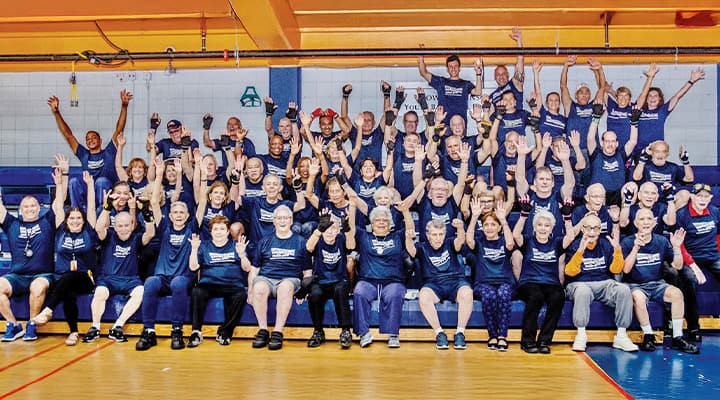
Jenny Enslein’s gym, Rock Steady Boxing at the MAR-JCC, is the largest single Rock Steady Boxing affiliate. It is also the only affiliate to offer the program at no cost to any of the participants.
"These people have enough burden just dealing with their disease," said Jenny. "I work hard to offer this program free of cost so that they can feel that the community is doing something for them."
This is possible thanks to Jenny’s tireless fundraising efforts, which include donations from the community, multiple grants (including one from the Parkinson’s Foundation), and dozens of volunteers.
Impressive Results
In her nine years with Rock Steady Boxing, Jenny has witnessed firsthand the difference it can make in someone’s life.
"We have boxers who come with walkers and graduate to canes. We have boxers who come with canes and graduate to no cane," said Jenny. "Our youngest boxer, who’s 43 years old, came to us with a walker and had difficulty speaking. He now runs and is fully able to speak."
Jenny recalled another boxer named Marc, who was in a wheelchair when he first started the program.
"Marc was able to transition from a wheelchair to a walker, and then from a walker to a cane. And then one remarkable day, Marc walked—by himself—several times back and forth across the basketball court. It was quite a sight!" said Jenny. "Marc’s courage and resilience are immeasurable."
Beyond the physical benefits of Rock Steady Boxing, Jenny says that what she loves most about the program is the sense of community.
"It’s like a family," she said. "The ones who regularly attend maintain and improve not just their physical health, but their cognitive health as well."
In fact, one observational study, in people with Parkinson’s disease, found that Rock Steady Boxing was associated with greater self-reported quality of life, higher exercise confidence, and perceived improvements across several areas compared to non-participants.1
These impressive results have caught the attention of the medical community.
"When I first started recruiting patients, my head coach Dany Weil and I visited every neurologist in Miami-Dade," said Jenny. "I didn’t have much success. I recruited our first 12 patients on my own."
Now, all of Jenny’s new patients come from neurologists’ referrals.
"Although these physicians have never set foot in our facility, they see firsthand the improvement and patient testimonials," said Jenny. "Now, any new patient diagnosed with Parkinson’s is prescribed PD medication and is referred to our program as a recommended part of their comprehensive PD treatment."
Beyond Exercise
Jenny’s influence on the Parkinson’s community has extended far beyond the 290 boxers who have participated in her program.
In 2022, the Parkinson’s Foundation, a national organization that funds research and provides educational resources, partnered with Jenny’s affiliate to conduct a genetic testing study.
Their results showed that out of 250 patients, only five came back positive for the Parkinson’s gene.
"This made me think, what happens to the other 245, like my husband, who did not test positive for the gene?" said Jenny. "So, I dug deeper. I went through the intake paperwork of each of my boxers, and I found what Dr. Mark Hyman (my husband’s doctor) had been telling him for years: Environmental exposure could be an underlying cause of Parkinson’s."8
Jenny found that the largest group of boxers were former dentists, who had worked with mercury for years. The second largest group were golfers, who are exposed to pesticides.
After that came hairdressers, Vietnam vets, and those growing up on farms.
Jenny has presented these findings—and about the success of Rock Steady Boxing—on numerous occasions as a guest speaker for the Parkinson’s Foundation.
"The presentation blows the minds of some of these neurologists because conventional doctors are not in tune with all of this," said Jenny. "They treat the symptoms, but they don’t try to analyze the root."
This is also why Jenny believes that following a healthy diet and taking supplements is important for supporting their overall health.
For example, she says that melatonin can be helpful for sleep issues that many Parkinson’s patients experience. She also tells them about the benefits of magnesium, vitamin D, fish oil, and zinc for addressing issues such as sleep quality, mood, and constipation.
"Exercise is a big part of the puzzle, but it’s not the only piece," said Jenny.
This has been true for Jenny’s husband, Spencer.
Fourteen years into his Parkinson’s diagnosis, Spencer is doing remarkably well. He uses a cane for balance, but he is still able to maintain his independence and quality of life.
In addition to doing Rock Steady Boxing twice a week, Spencer does a number of other alternative therapies, including nutritional IV therapy (Myer’s cocktail), OsteoStrong therapy, hyperbaric oxygen therapy, acupuncture, yoga, massage, and more.
Spencer also takes more than 26 supplements.
"My husband’s neurologist has told him several times that if he hadn’t done everything he’s done, he would now be in a wheelchair."
Spencer—and others like him—are living proof of the powerful mantra they repeat at the end of every Rock Steady Boxing session:
I am not a patient.
I am a boxer.
Impossible is nothing.
Jenny continues to broaden her impact on the Parkinson’s community. Since 2022, she has served as a member of the Board of Directors of Rock Steady Boxing Indiana. And in 2026, she will become chairperson of the board, where she will help to oversee the entire Rock Steady Boxing organization.
"When I found Rock Steady Boxing, I knew it was going to be the tool to offer my husband a better quality of life and to give him hope. Now it’s gone beyond that," said Jenny. "It has given me an opportunity to turn my husband’s medical challenge into an opportunity to help others."
If you have any questions on the scientific content of this article, please call a Life Extension Wellness Specialist at 1-866-864-3027.
References
- Larson D, Yeh C, Rafferty M, et al. High satisfaction and improved quality of life with Rock Steady Boxing in Parkinson’s disease: results of a large-scale survey. Disabil Rehabil. 2022 Oct;44(20):6034-41.
- Moore A, Yee E, Willis BW, et al. A Community-based Boxing Program is Associated with Improved Balance in Individuals with Parkinson’s Disease. Int J Exerc Sci. 2021;14(3):876-84.
- Hermanns M, Mastel-Smith B, Donnell R, et al. Counterpunching to improve the health of people with Parkinson’s disease. J Am Assoc Nurse Pract. 2021 Apr 7;33(12):1230-9.
- Feng YS, Yang SD, Tan ZX, et al. The benefits and mechanisms of exercise training for Parkinson’s disease. Life Sci. 2020 Mar 15;245:117345.
- Shearin S, Braitsch M, Querry R. The effect of a multi-modal boxing exercise program on cognitive locomotor tasks and gait in persons with Parkinson disease. NeuroRehabilitation. 2021;49(4):619-27.
- Combs SA, Diehl MD, Staples WH, et al. Boxing training for patients with Parkinson disease: a case series. Phys Ther. 2011 Jan;91(1):132-42.
- Malczynska-Sims P, Chalimoniuk M, Wronski Z, et al. High-intensity interval training modulates inflammatory response in Parkinson’s disease. Aging Clin Exp Res. 2022 Sep;34(9):2165-76.
- Tanner CM, Ostrem JL. Parkinson’s Disease. New England Journal of Medicine. 2024;391(5):442-52.


Wellness
Specialists
1-800-226-2370 - This service is FREE
7:30 AM - 12 AM (ET) Mon-Fri | 9 AM - 12 AM (ET) Sat-Sun