


Life Extension Magazine.

As We See It: The Global Rise of Neck Pain
Neck pain affects more than 200 million people worldwide. An effective solution is to engage in pain-relieving physical activities (and avoid underlying causes). An ayurvedic botanical combination can be part of a complementary approach.
By William Faloon.

Low back pain is the leading cause of worldwide disability, but neck pain ranks fourth.1 Global neck pain burden is forecasted to increase by more than 30% in the next three decades.2
Although the causes of neck pain vary, several common risk factors have been associated with an increased risk, including:
Insufficient physical activity3 and obesity,4
Improper physical activity/poor form/improper posture,5,6
Prolonged use of digital devices such as smartphones,7 laptops, or tablets,7 and
Psychological stress.8
Women are more likely to be affected, a difference that may be related to biological differences in musculoskeletal development and pain perception.2,9,10
Many still attempt to treat their neck pain with massages and NSAIDs, which do not produce meaningful improvements in the long run.11,12
For most individuals, the primary recommendation is to engage in proper physical activity.
A review of randomized controlled trials evaluating different types of physical activity found that strength training, motor control training (subset of physical therapy), and yoga/Pilates/Tai Chi/Qigong produced significant improvements in neck pain compared with no treatment.
The preliminary conclusion was that none of these exercise interventions were superior to the other.13
These different exercise strategies can influence neck stability in distinct ways by:
- Targeting deep cervical muscles,
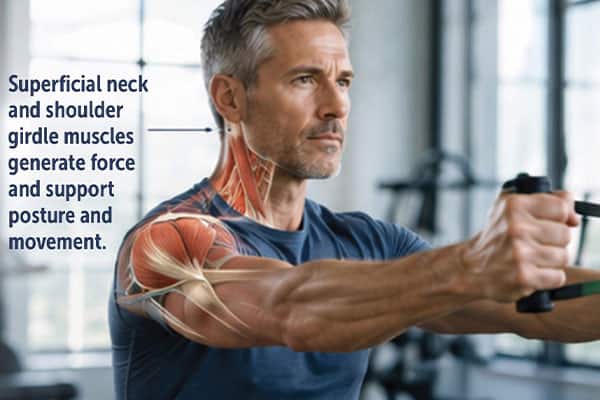
- Strengthening superficial neck and shoulder girdle muscles, and
- Improving stabilization/muscular endurance during arm movements that place load on the neck.
As a result, no single exercise intervention is universally effective.14
An article on page 52 describes a new approach of utilizing a combination of ayurvedic, anti-inflammatory botanicals — Curcuma longa and Boswellia serrata — that resulted in clinical reductions in neck pain, stiffness, and neck-related disability.15
This botanical combination may represent a complementary approach to a multi-faceted strategy of alleviating neck pain.
For longer life,

William Faloon, Co-Founder, Life Extension®
References
- Fandim JV, Almeida de Oliveira L, Yamato TP, et al. Telerehabilitation for neck pain. Cochrane Database Syst Rev. 2025;8(8):Cd014428.
- Sun C, Lin H, Zhang Z, et al. Global, regional and national burden of neck pain in children and adolescents: GBD 2021 systematic analysis. Front Neurol. 2025;16:1625954.
- Yakdan S, Benedict B, Singh P, et al. Association of activity with the risk of developing musculoskeletal pain in the All of Us research program. J Pain. 2025;35:105516.
- Nilsen TI, Holtermann A, Mork PJ. Physical exercise, body mass index, and risk of chronic pain in the low back and neck/shoulders: longitudinal data from the Nord-Trondelag Health Study. Am J Epidemiol. 2011;174(3):267-73.
- Hlavenka TM, Christner VFK, Gregory DE. Neck posture during lifting and its effect on trunk muscle activation and lumbar spine posture. Appl Ergon. 2017;62:28-33.
- Available at: https://www.health.harvard.edu/pain/is-your-workout-giving-you-a-stiff-neck. Accessed July 13, 2026.
- Chen YJ, Hu CY, Wu WT, et al. Association of smartphone overuse and neck pain: a systematic review and meta-analysis. Postgrad Med J. 2025;101(1197):620-6.
- Ortego G, Villafañe JH, Doménech-García V, et al. Is there a relationship between psychological stress or anxiety and chronic nonspecific neck-arm pain in adults? A systematic review and meta-analysis. J Psychosom Res. 2016;90:70-81.
- Ostrom C, Bair E, Maixner W, et al. Demographic Predictors of Pain Sensitivity: Results From the OPPERA Study. J Pain. 2017;18(3):295-307.
- Vasavada AN, Danaraj J, Siegmund GP. Head and neck anthropometry, vertebral geometry and neck strength in height-matched men and women. J Biomech. 2008;41(1):114-21.
- Gross AR, Lee H, Ezzo J, et al. Massage for neck pain. Cochrane Database Syst Rev. 2024;2(2):Cd004871.
- Machado GC, Maher CG, Ferreira PH, et al. Non-steroidal anti-inflammatory drugs for spinal pain: a systematic review and meta-analysis. Ann Rheum Dis. 2017;76(7):1269-78.
- de Zoete RM, Armfield NR, McAuley JH, et al. Comparative effectiveness of physical exercise interventions for chronic non-specific neck pain: a systematic review with network meta-analysis of 40 randomised controlled trials. Br J Sports Med. 2020.
- Rasmussen-Barr E, Halvorsen M, Bohman T, et al. Summarizing the effects of different exercise types in chronic neck pain - a systematic review and meta-analysis of systematic reviews. BMC Musculoskelet Disord. 2023;24(1):806.
- Mamatha K, Prabhakaran P, Syam Das S, et al. A full-spectrum Boswellia serrata extract with enhanced bioavailability, and its co-delivered system with curcumin alleviate pain and stiffness associated with moderate spondylitis: a randomized double-blind, placebo-controlled, 3-arm study. Front Pharmacol. 2025;16:1577429.


Wellness
Specialists
1-800-226-2370 - This service is FREE
7:30 AM - 12 AM (ET) Mon-Fri | 9 AM - 12 AM (ET) Sat-Sun