

Life Extension Magazine®

Testosterone on the Rise
Between 2018 and 2022, testosterone use among U.S. men aged 35-44 increased by 58%. Optimal testosterone levels may lower the risk of obesity, type 2 diabetes, and cardiovascular disease
By William Faloon.

A recent analysis of testosterone drug use among U.S. men found that:
"Between 2018 and 2022, testosterone replacement therapy (TRT) prescriptions in the U.S. rose by 27%."
The sharpest increase was observed among men aged 35–44, with prescriptions climbing by 58%.1
One of the key factors behind this trend is likely the growth of direct-to-consumer telehealth platforms, making testosterone replacement therapy (TRT) more accessible through online consultations.2,3
In the mid-1990s, Life Extension® along with a group of anti-aging physicians pioneered the use of testosterone in men who were testosterone deficient (and often estrogen dominant).
Influential figures are now sounding the alarm on the importance of maintaining optimal testosterone levels4 to potentially lower the risk of obesity, type 2 diabetes, and cardiovascular disease.

In men with low testosterone and metabolic dysfunction, restoring testosterone to youthful ranges in some studies has been shown to improve insulin sensitivity and 5,6 lean mass,5,7 and reduce total cholesterol,8 fat mass,5 waist circumference,7,8 and inflammatory markers.5,9
We are gratified to see the widespread acceptance of this once controversial approach to regress certain aspects of degenerative aging.
Men today have several options to restore a more youthful sex hormone balance with or without prescription medications.
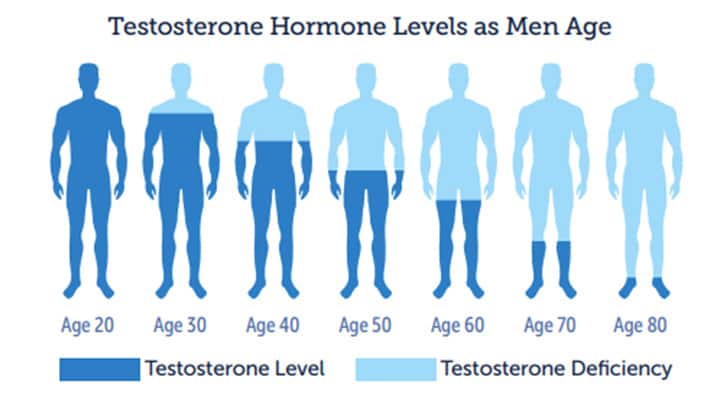
The Silent Crisis of Low Testosterone
Most men pursue testosterone therapy to restore lost muscle mass or to treat deficient testosterone, a condition known as hypogonadism.
Far fewer recognize the potential life-threatening consequences of low testosterone. This oversight may be contributing to a silent but insidious health crisis.
Scientific literature and Life Extension’s decades-long analysis reveal that low testosterone is not merely a quality-of-life issue. It may be a biological accelerant of aging and chronic disease.
Low levels of testosterone in men are associated with:
- Memory issues and elevated Alzheimer’s risk in aging men,10
- Mood disturbances and depression,11,12
- Stubborn belly fat,13 and metabolic dysfunction,14,15
- Frailty of bones, increasing the risk of osteoporosis,16
- Greater cardiovascular risk, including endothelial dysfunction,17 inflammation,17 and arterial stiffening.18
Low testosterone is associated with higher levels of pro-inflammatory cytokines like interleukin-6, as well as C-reactive protein (CRP), markers of chronic inflammation.19
Testosterone normally helps modulate inflammatory signals,20 which could help explain why when testosterone levels drop, systemic inflammation tends to ramp up,19,21,22 which sets the stage for multiple diseases.17,23

After age 30, testosterone normally begins a steady 1-2% annual decline.24 Research suggests that mean testosterone levels today are falling faster independent of aging. This is likely due in part to the increased incidence of obesity, whereby excess visceral fat converts testosterone into estrogen.25
More men are having blood tests to assess their testosterone and estrogen levels and using prescription medications to restore a more youthful balance.
Most are paying between $1,200 and $2,600 per year for these prescription drugs and medical consultations.4
An alternative approach is the use of botanical extracts that can enhance levels of total and free testosterone and support youthful vigor and physical strength.
The Replenish Falling Testosterone Levels article of this issue describes studies supporting the use of plant-derived compounds to restore a more youthful hormone balance in men.
For longer life,

William Faloon, Co-Founder, Life Extension®
References
- Selinger S, Thallapureddy A. Cross-sectional analysis of national testosterone prescribing through prescription drug monitoring programs, 2018-2022. PLoS One. 2024;19(8):e0309160.
- Dubin JM, Fantus RJ, Halpern JA. Testosterone replacement therapy in the era of telemedicine. Int J Impot Res. 2022 Nov;34(7):663-8. 3.
- Jesse E, Sellke N, Rivero MJ, et al. Practice Comparison and Cost Analysis of Direct-to-Consumer Telemedicine Platforms Offering Testosterone Therapy. J Sex Med. 2022 Nov;19(11):1608-15.
- Available at: https://www.wsj.com/health/healthcare/testosterone-clinics-telehealth-steroids-474835d5?mod=Searchresults_pos4&page=1. Accessed 06/25/2025,
- Dhindsa S, Ghanim H, Batra M, et al. Insulin Resistance and Inflammation in Hypogonadotropic Hypogonadism and Their Reduction After Testosterone Replacement in Men With Type 2 Diabetes. Diabetes Care. 2016 Jan;39(1):82-91.
- Tishova Y, Kalinchenko S, Mskhalaya G, et al. Testosterone therapy reduces insulin resistance in men with adult-onset testosterone deficiency and metabolic syndrome. Results from the Moscow Study, a randomized controlled trial with an open-label phase. Diabetes Obes Metab. 2024 Jun;26(6):2147-57.
- Saad F. Testosterone Therapy and Glucose Homeostasis in Men with Testosterone Deficiency (Hypogonadism). Adv Exp Med Biol. 2017;1043:527-58.
- Kapoor D, Goodwin E, Channer KS, et al. Testosterone replacement therapy improves insulin resistance, glycaemic control, visceral adiposity and hypercholesterolaemia in hypogonadal men with type 2 diabetes. Eur J Endocrinol. 2006 Jun;154(6):899-906.
- Heufelder AE, Saad F, Bunck MC, et al. Fifty-two-week treatment with diet and exercise plus transdermal testosterone reverses the metabolic syndrome and improves glycemic control in men with newly diagnosed type 2 diabetes and subnormal plasma testosterone. J Androl. 2009 Nov-Dec;30(6):726-33.
- Marriott RJ, Murray K, Flicker L, et al. Lower serum testosterone concentrations are associated with a higher incidence of dementia in men: The UK Biobank prospective cohort study. Alzheimers Dement. 2022 Oct;18(10):1907-18.
- Zito S, Nosari G, Pigoni A, et al. Association between testosterone levels and mood disorders: A minireview. J Affect Disord. 2023 Jun 1;330:48-56.
- Almeida OP, Yeap BB, Hankey GJ, et al. Low free testosterone concentration as a potentially treatable cause of depressive symptoms in older men. Arch Gen Psychiatry. 2008 Mar;65(3):283-9.
- Kelly DM, Jones TH. Testosterone and obesity. Obes Rev. 2015 Jul;16(7):581-606. 14. Blaya R, Blaya P, Rhoden L, et al. Low Testosterone Levels and Metabolic Syndrome in Aging Male. Curr Pharm Des. 2017 Nov 28;23(30):4470-4.
- Lapauw B, Kaufman JM. MANAGEMENT OF ENDOCRINE DISEASE: Rationale and current evidence for testosterone therapy in the management of obesity and its complications. Eur J Endocrinol. 2020 Dec;183(6):R167-R83.
- Gaffney CD, Pagano MJ, Kuker AP, et al. Osteoporosis and Low Bone Mineral Density in Men with Testosterone Deficiency Syndrome. Sex Med Rev. 2015 Oct;3(4):298-315.
- Babcock MC, DuBose LE, Witten TL, et al. Oxidative Stress and Inflammation Are Associated With Age-Related Endothelial Dysfunction in Men With Low Testosterone. J Clin Endocrinol Metab. 2022 Jan 18;107(2):e500-e14.
- Vlachopoulos C, Ioakeimidis N, Miner M, et al. Testosterone deficiency: a determinant of aortic stiffness in men. Atherosclerosis. 2014 Mar;233(1):278-83.
- Grandys M, Majerczak J, Zapart-Bukowska J, et al. Lowered Serum Testosterone Concentration Is Associated With Enhanced Inflammation and Worsened Lipid Profile in Men. Front Endocrinol (Lausanne). 2021;12:735638.
- Ainslie RJ, Simitsidellis I, Kirkwood PM, et al. RISING STARS: Androgens and immune cell function. J Endocrinol. 2024 Jun 1;261(3).
- Osmancevic A, Daka B, Michos ED, et al. The Association between Inflammation, Testosterone and SHBG in men: A cross-sectional Multi-Ethnic Study of Atherosclerosis. Clin Endocrinol (Oxf). 2023 Aug;99(2):190-7.
- Bobjer J, Katrinaki M, Tsatsanis C, et al. Negative association between testosterone concentration and inflammatory markers in young men: a nested cross-sectional study. PLoS One. 2013;8(4):e61466.
- Rovira-Llopis S, Banuls C, de Maranon AM, et al. Low testosterone levels are related to oxidative stress, mitochondrial dysfunction and altered subclinical atherosclerotic markers in type 2 diabetic male patients. Free Radic Biol Med. 2017 Jul;108:155-62.
- Fleseriu M, Hashim IA, Karavitaki N, et al. Hormonal Replacement in Hypopituitarism in Adults: An Endocrine Society Clinical Practice Guideline. J Clin Endocrinol Metab. 2016 Nov;101(11):3888-921.
- Xu X, Wang L, Luo D, et al. Effect of Testosterone Synthesis and Conversion on Serum Testosterone Levels in Obese Men. Horm Metab Res. 2018 Sep;50(9):661-70.


Wellness
Specialists
1-800-226-2370 - This service is FREE
7:30 AM - 12 AM (ET) Mon-Fri | 9 AM - 12 AM (ET) Sat-Sun