

Life Extension Magazine®

Plummeting Interest in Sex
Sexual desire and frequency is declining in developed countries and may be inflicting disastrous effects on our mental health.
By William Faloon.

Men and women are having less sex than they used to.1
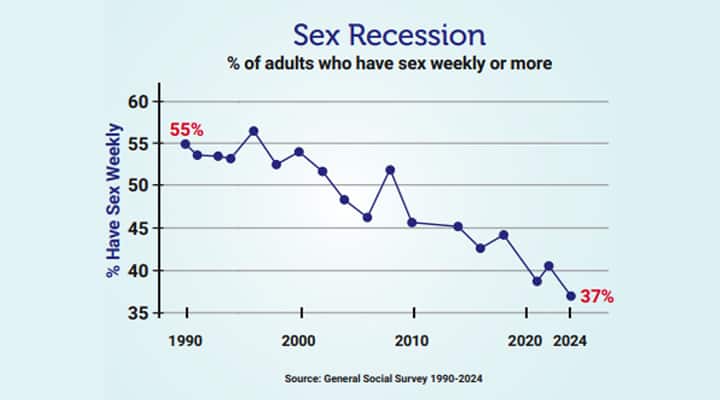
Survey data of people aged 18-64 found 37% reported having sex at least once a week in 2024, which is down from 55% in 1990.2
This survey showed the trend persisted across all sexual orientations with both married and single people up to age 64.2,3 This confirms a trend that has been observed previously by academic and institutional researchers.4,5
America and many other developed countries such as the U.K., Australia, Germany, and Japan are in the middle of what is being called a "sex recession."1-3 This has been accompanied by sharply lower fertility rates in many countries, such as these.6
This article describes some of the possible reasons for plummeting interest in sex, its consequences, and possible solutions for the men with low sexual function.
Why People Are Having Less Sex
Multiple possible reasons have been proposed for why people are having less sex, including economic stressors,7,8 stunted social skills,4,9 the ready supply of online entertainment,4 and prescription drug side effects.8
In men, the loss of sexual desire can also be blamed on declining testosterone which plays a pivotal role in sexual function and desire.10
New reports show that men today have less testosterone than their fathers did at the same age.11,12Consequences of Less Sex
Younger adults, such as millennials and Gen Z, are reporting the least sexual activity, which is interesting because many people mistakenly believe that these generations are having the most sex.13 The decline is also evident across most generations, all sexual orientations, singles, and married couples.3,4
This may be an important finding, in terms of overall health. A cross-sectional study on 1,326 men over age 50 found that men with a self-reported decline in sexuality (sexual desire/behaviors/activities) had significantly worse psychological life satisfaction scores including a greater prevalence of depression compared to men who did not have a decline in sexuality.

Among those without declining sexuality and no erectile dysfunction, the prevalence of depression was 47%. Those with declining sexuality had a prevalence of depression of 68.5%, which rose to 75% when those without erectile dysfunction were excluded.14
A study published in 2025 included about 16,000 adults aged 20-59 and found that compared to those who reported having sex less than once a month, those who had sex at least once a week had lower odds of depression in both men and women. The authors suggest that this may be the optimal sexual frequency to provide protective effects on psychological wellbeing.15
Restoring youthful testosterone may help men with low testosterone who struggle with poor sexual function and desire.16
Plant-Based Support for Sexual Vitality
Sexual frequency is declining in America as well as in other developed countries around the world, and that may be affecting our health.
A potential solution exists for men.
A combination of pomegranate and cacao extracts was shown to significantly increase testosterone levels and sexual function.
In a placebo-controlled study, men receiving a pomegranate-cacao combination increased their sexual frequency from 1-2 times a month to 4-6 times a week.17
Another controlled trial found that a bioavailable luteolin boosted testosterone compared to controls.18
Together, these plant compounds may help restore men’s sexual function and help lift people out of the sex recession.
The article, Boost Male Sexual Health and Function discusses sexual health, the role of testosterone, and plant-based approaches to support sexual drive.
For women seeking to increase their sexual function, call a wellness specialist for potential solutions.
For longer life,

William Faloon, Co-Founder, Life Extension®
References
- Herbenick D, Rosenberg M, Golzarri-Arroyo L, et al. Changes in Penile-Vaginal Intercourse Frequency and Sexual Repertoire from 2009 to 2018: Findings from the National Survey of Sexual Health and Behavior. Arch Sex Behav. 2022 Apr;51(3):1419-33.
- Available at: https://gssdataexplorer.norc.org/variables/5057/vshow. Accessed February, 2026.
- Available at: https://gssdataexplorer.norc.org/about. Accessed Februrary 19, 2026.
- Ueda P, Mercer CH, Ghaznavi C, et al. Trends in Frequency of Sexual Activity and Number of Sexual Partners Among Adults Aged 18 to 44 Years in the US, 2000-2018. JAMA Netw Open. 2020 Jun 1;3(6):e203833.
- Twenge JM, Sherman RA, Wells BE. Declines in Sexual Frequency among American Adults, 1989-2014. Arch Sex Behav. 2017 Nov;46(8):2389-401.
- Fertility GBD, Forecasting C. Global fertility in 204 countries and territories, 1950-2021, with forecasts to 2100: a comprehensive demographic analysis for the Global Burden of Disease Study 2021. Lancet. 2024 May 18;403(10440):2057-99.
- Turner JJ, Crapo JS, Kopystynska O, et al. Economic distress and perceptions of sexual intimacy in remarriage. Front Psychol. 2022;13:1056180.
- Wu L, Rao M, Chen Y, et al. Risk assessment of the top 60 drugs for drug-related sexual dysfunction: a disproportion analysis from the Food and Drug Administration adverse event reporting system. J Sex Med. 2025 Nov 2;22(11):2058-69.
- Lei L, South SJ. Explaining the Decline in Young Adult Sexual Activity in the United States. Journal of Marriage and Family. 2020 09/28;83(1):280-95.
- Corona G, Maggi M. The role of testosterone in male sexual function. Rev Endocr Metab Disord. 2022 Dec;23(6):1159-72.
- Travison TG, Araujo AB, O’Donnell AB, et al. A population-level decline in serum testosterone levels in American men. J Clin Endocrinol Metab. 2007 Jan;92(1):196-202.
- Mazur A, Westerman R, Mueller U. Is rising obesity causing a secular (age-independent) decline in testosterone among American men? PLoS One. 2013;8(10):e76178.
- Twenge JM, Sherman RA, Wells BE. Sexual Inactivity During Young Adulthood Is More Common Among U.S. Millennials and iGen: Age, Period, and Cohort Effects on Having No Sexual Partners After Age 18. Arch Sex Behav. 2017 Feb;46(2):433-40.
- Lu Y, Fan S, Cui J, et al. The decline in sexual function, psychological disorders (anxiety and depression) and life satisfaction in older men: A cross-sectional study in a hospital-based population. Andrologia. 2020 Jun;52(5):e13559.
- Chen M, Yi R, Zhang Z. Optimal sexual frequency may exist and help mitigate depression odds in young and middle-aged U.S. citizens: A cross-sectional study. J Affect Disord. 2025 Apr 15;375:165-73.
- Rizk PJ, Kohn TP, Pastuszak AW, et al. Testosterone therapy improves erectile function and libido in hypogonadal men. Curr Opin Urol. 2017 Nov;27(6):511-5.
- Srivastava MK, Singh G, Kodur RR, et al. A Combination of Punica granatum Fruit Rind and Theobroma cacao Seed Extracts Enhances Sexual Function in Aging Males in a Randomized, Double-blind, Placebo-controlled Study. Int J Med Sci. 2025;22(2):383-97.
- Akay. A Randomized, Double-Blind, Placebo-Controlled, Parallel-Group, Comparative Evaluation of TLF-20 on Relevant Sexual Biomarkers in Middle Aged Men with Low Testosterone. 2025.


Wellness
Specialists
1-800-226-2370 - This service is FREE
7:30 AM - 12 AM (ET) Mon-Fri | 9 AM - 12 AM (ET) Sat-Sun