

Life Extension Magazine®

Superfoods: Goji Berries
Rich in zeaxanthin and other nutrients, goji berries have been investigated in clinical studies for their role in supporting eye health and metabolic health markers, including lipid profile, waist circumference, and glucose and insulin regulation.
Scientifically reviewed by: Gary Gonzalez, MD, in May 2026. Written by: Laurie Mathena.
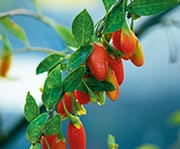
Goji berries are a small, red-orange fruit packed with an array of nutrients and bioactive compounds.
Long prized in traditional Chinese medicine for their anti-aging and health-promoting properties,1 these berries have been shown in modern research to be a promising functional food with antioxidant, anti-inflammatory, and metabolic benefits.2,3
Goji berries provide nutrients like vitamin C, minerals (potassium and copper), fatty acids (linolenic and oleic acid), amino acids (proline and serine), and flavonoids such as anthocyanins.4
One of goji berries' primary active components, called Lycium barbarum polysaccharides, provides antioxidant, immunoregulative, and anti-apoptotic effects, while reducing DNA damage.5
Goji berries are one of the richest dietary sources of zeaxanthin,6 a carotenoid shown to protect against eye damage.7
In one study, eating 15 grams of goji berries (estimated to contain 3 mg zeaxanthin) daily for 28 days more than doubled the levels of zeaxanthin in the blood.8
In a pilot trial, adults who ate 28 grams of goji berries five times per week for 90 days had significant increases in macular pigment optical density, an indicator for evaluating the risk and progression of age-related macular degeneration, a major cause of vision loss.9
Even though goji berries have a relatively high sugar content (about 13 grams per one-ounce serving),10 they may still offer metabolic benefits.
Patients with metabolic syndrome, who added 14 grams of goji berry to a healthy diet for 45 days had improvements in lipid profiles, reduced waist circumference, and had increases in antioxidants like glutathione and catalase, compared to the control group.2
In a separate randomized controlled trial, consuming 15 grams of dried goji berries daily for 16 weeks, combined with a healthy diet, led to significant increases in HDL cholesterol, reductions in the Framingham 10-year Cardiovascular Disease score, and decreases in vascular age.11,12
Goji berries are most commonly consumed in their dried form (like raisins). They can be added to oatmeal, yogurt, or smoothies, or eaten separately as a snack.
References
- Yao R, Heinrich M, Weckerle CS. The genus Lycium as food and medicine: A botanical, ethnobotanical and historical review. J Ethnopharmacol. 2018 Feb 15;212:50-66.
- de Souza Zanchet MZ, Nardi GM, de Oliveira Souza Bratti L, et al. Lycium barbarum Reduces Abdominal Fat and Improves Lipid Profile and Antioxidant Status in Patients with Metabolic Syndrome. Oxid Med Cell Longev. 2017;2017:9763210.
- Shunkai H, Yiting X, Shadrack SM, et al. Lycium barbarum (goji berry): A comprehensive review of chemical composition, bioactive compounds, health-promoting activities, and applications in functional foods and beyond. Food Chem. 2025 Dec 25;496(Pt 1):146588.
- Vidovic BB, Milincic DD, Marcetic MD, et al. Health Benefits and Applications of Goji Berries in Functional Food Products Development: A Review. Antioxidants (Basel). 2022 Jan 27;11(2).
- Gao Y, Wei Y, Wang Y, et al. Lycium Barbarum: A Traditional Chinese Herb and A Promising Anti-Aging Agent. Aging Dis. 2017 Dec;8(6):778-91.
- Li X, Holt RR, Keen CL, et al. Potential roles of dietary zeaxanthin and lutein in macular health and function. Nutr Rev. 2023 May 10;81(6):670-83.
- Yang SF, Roberts JE, Liu QH, et al. Zeaxanthin and Lutein in the Management of Eye Diseases. J Ophthalmol. 2016;2016:4915916.
- Cheng CY, Chung WY, Szeto YT, et al. Fasting plasma zeaxanthin response to Fructus barbarum L. (wolfberry; Kei Tze) in a food-based human supplementation trial. Br J Nutr. 2005 Jan;93(1):123-30.
- Li X, Holt RR, Keen CL, et al. Goji Berry Intake Increases Macular Pigment Optical Density in Healthy Adults: A Randomized Pilot Trial. Nutrients. 2021 Dec 9;13(12).
- Available at: https://tools.myfooddata.com/nutrition-facts/2052118/oz/1. Accessed March 13, 2026.
- Toh DWK, Xia X, Sutanto CN, et al. Enhancing the cardiovascular protective effects of a healthy dietary pattern with wolfberry (Lycium barbarum): A randomized controlled trial. Am J Clin Nutr. 2021 Jul 1;114(1):80-9.
- Toh DWK, Xia X, Sutanto CN, et al. Enhancing the cardiovascular protective effects of a healthy dietary pattern with wolfberry (Lycium barbarum): A randomized controlled trial. Am J Clin Nutr. 2021 Jul 1;114(1):80-89.


Wellness
Specialists
1-800-226-2370 - This service is FREE
7:30 AM - 12 AM (ET) Mon-Fri | 9 AM - 12 AM (ET) Sat-Sun