

Life Extension Magazine®

Cost-Effective Option to Boost NAD+
NMN is an effective, lower cost way to support NAD+. Clinical trials show that NMN significantly increases circulating levels of NAD+ in older adults.
By Michael Downey.
There’s a good reason why NAD+ is found in every living cell in our bodies.1
NAD+ is required for hundreds of critical cellular processes, including energy production, DNA repair, and immune responses.2-4
It plays critical roles in processes related to aging at the cellular level.2,5
But NAD+ levels decrease as we age, which can contribute to age-related functional decline.2,6,7 NAD+ precursors are compounds that have been shown to boost NAD+ when taken orally and have the potential to support healthier aging.8
Life Extension® readers are familiar with the NAD+ precursor nicotinamide riboside or NR. It was introduced to readers of this publication in 2014. A lower-cost and effective
NAD+ precursor, called NMN (nicotinamide mononucleotide), has recently entered the commercial marketplace.
In controlled human trials, oral NMN supplementation significantly increased blood NAD+ levels compared to placebo. NMN is a lower-cost way to boost NAD+.9,10
NMN may support healthy aging at the cellular level via increased NAD+ production.
The Importance of NAD+
The coenzyme NAD+ (nicotinamide adenine dinucleotide) is essential for normal cellular function.4,11
Without ample NAD+, cells cannot properly convert food into usable energy or effectively mitigate DNA damage.4,11 NAD+ is required for the normal function of over 300 proteins, including:2
- Sirtuins, which maintain mitochondrial health, suppress chronic inflammation, and help regulate cell metabolism,12,13
- PARPs (poly-ADP ribose polymerases), which handle DNA repair, autophagy (cell cleanup), and gene regulation,2,13 and
- CD38 (cyclic ADP-hydrolysase), which supports immune responses and calcium signaling.2,13
NAD+ is critical for all cells. Preclinical data shows that it is a key mediator in energy metabolism, DNA repair, cellular antioxidant defenses, inflammation regulation, and more.2,5,13-15
Why NAD+ Declines as You Age
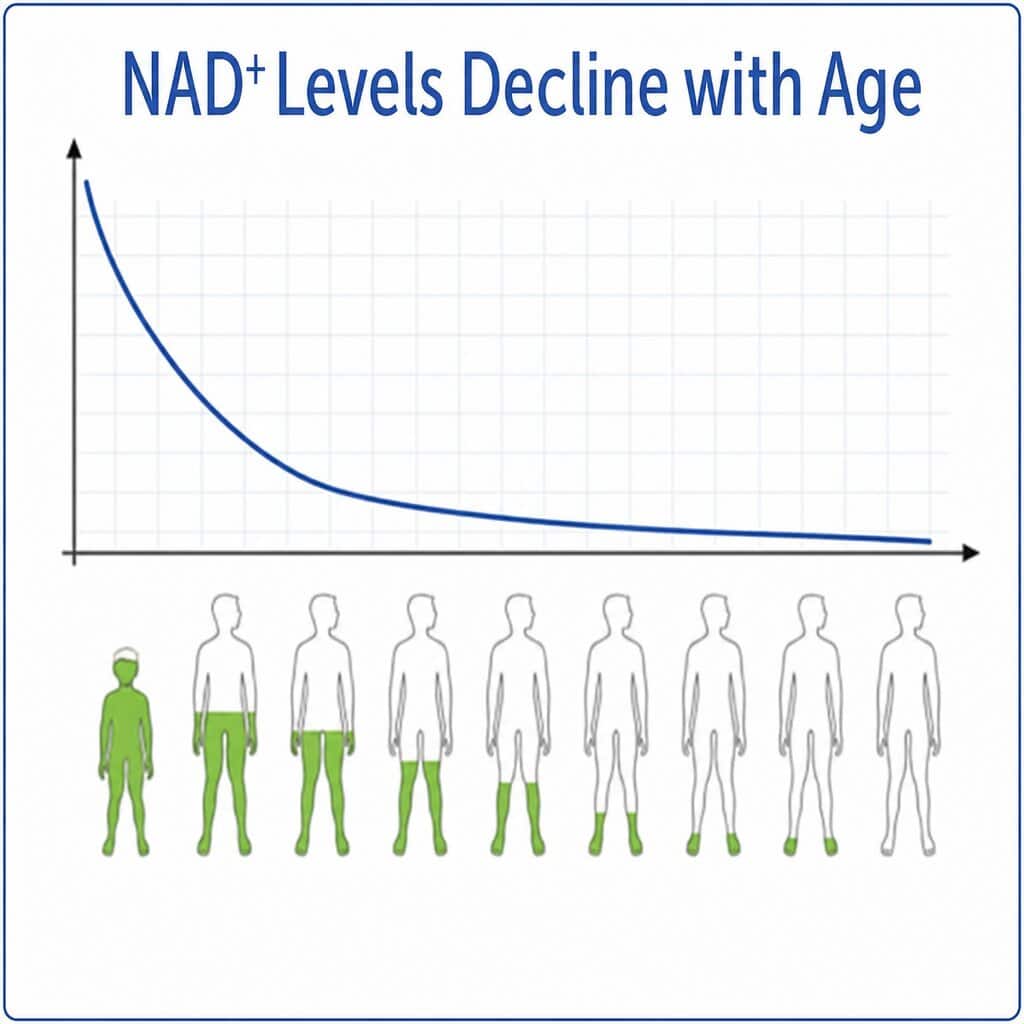
NAD+ levels progressively decline across multiple human tissues and have been associated with age-related chronic disorders and metabolic dysfunction.6,16
With age, cellular damage accumulates due to inflammation, oxidative stress, and DNA damage.
Sirtuins, PARPs, and CD38 help mitigate this damage.13,16,17 But to function properly, these critical proteins “consume” NAD+ thereby depleting levels.18 This decline is continuous and progressive. One human observational study showed that by age 50, NAD+ levels can drop by about 50%.19
Decreased NAD+ levels are associated with reduced mitochondrial function and increased risk of premature aging and chronic age-related conditions.16,17,19,20
Restoring NAD+ Levels
Orally consuming NAD+ is not an effective way to replenish levels. In addition to being poorly absorbed, it cannot readily pass through the cell membrane intact.21,22
To get around this problem, scientists studied NAD+ precursors, compounds that can be taken orally to boost NAD+. Two precursors have been shown in clinical studies to raise blood NAD+ levels significantly, efficiently, and safely:
NR (nicotinamide riboside),23,24 and
NMN (nicotinamide mononucleotide).9,10
A Lower-Cost Option
In 2014, Life Extension researchers were among the first to recognize the importance of boosting NAD+ throughout the body for cellular health.
Nicotinamide riboside was recommended 12 years ago as a method to boost NAD+ levels.
Another option to boost NAD+ is to supplement using NMN.
In 2022, however, the FDA formally classified NMN as a drug.25
In late 2025, that classification was removed, allowing NMN to re-enter the consumer marketplace as an officially recognized dietary supplement.26,27
Both NR and NMN boost NAD+ levels in a similar fashion and at equivalent levels. However, NMN can be produced at a lower cost.
This allows aging individuals to boost their NAD+ levels in a more cost-effective way.
NMN and NR have both been clinically shown to boost NAD+ levels. They have overlapping as well as unique pathways for cellular entry.17
NR has two main pathways:
- NR can be directly transported into the cell where it then needs to be converted into NMN to produce NAD+.
- NR can be metabolized by the gut before entering the cell and producing NAD+.
NMN has three main pathways:
- NMN is converted into NR to enter the cell where it then gets converted back into NMN to produce NAD+.
- NMN can also be metabolized by the gut before entering the cell and producing NAD+.
- NMN appears to have a unique cell transporter that allows for direct entry into the cell where it produces NAD+. (However, this is evolving science and has so far only been described in animal studies.)28
Importantly, regardless of the pathways that NR or NMN use, studies have shown increases in NAD+ production.
What You Need To Know
A New Alternative for Boosting NAD+
- NAD+ (nicotinamide adenine dinucleotide) is critical to cellular processes that support healthy aging, including energy metabolism, DNA repair, and immune responses.
- NAD+ levels drop with older age. The precursor NMN (nicotinamide mononucleotide), taken orally, can be converted into NAD+ in the body to help boost levels.
- In animal studies, oral NMN increased lifespan, increased energy metabolism and physical activity, reduced frailty, and decreased age-related gene-expression changes.
- In clinical studies of older men and women, NMN significantly increased circulating NAD+ levels.
- NMN (nicotinamide mononucleotide) is a NAD⁺ precursor that has recently become commercially available at a relatively low cost.
Benefits of NMN
Preclinical studies suggest that NMN may support aspects of healthy aging by boosting NAD+.
In one study, giving mice NMN for 12 months:29
- Increased energy metabolism,
- Boosted physical activity levels,
- Decreased age-associated weight gain,
- Improved insulin sensitivity and blood lipid levels, and
- Reduced age-related gene-expression changes.
A second study administered NMN throughout the lifespan of a premature aging mouse model, starting at an early age. These mice exhibited:30
- Increased lifespan and improved median life expectancy,
- Reduced frailty, and
- Better overall health.
Validated in Clinical Studies
In a clinical study, healthy older men (mean age 71) were given 250 mg of NMN or a placebo.
After 12 weeks, NMN significantly increased NAD+ levels compared to placebo.9
In another clinical study, healthy older men and women (mean age 69) were given 250 mg of NMN or a placebo.
Again, after 12 weeks, NMN significantly increased NAD+ levels compared to the placebo group.10
In both trials, NMN also increased levels of other NAD+ precursors and intermediates. This provides additional evidence that NMN raises NAD+ levels.9,10
These higher NAD+ levels may help support healthy aging.
Summary

NAD+ (nicotinamide adenine dinucleotide) is a compound found in every living cell in the body. It’s required for essential cellular processes like energy production, DNA repair, and immune function.
Levels of NAD+ decline with age, reducing mitochondrial function and accelerating aging. The precursor NMN (nicotinamide mononucleotide), taken orally, can boost NAD+ levels.
Clinical studies show that NMN safely increases NAD+ levels in older adults, which may support healthy aging at the cellular level.
Consumers now have access to NMN or NR. The major difference from our view is that NMN costs far less than NR. n
If you have any questions on the scientific content of this article, please call a Life Extension Wellness Specialist at 1-866-864-3027.
References
- Amjad S, Nisar S, Bhat AA, et al. Role of NAD(+) in regulating cellular and metabolic signaling pathways. Mol Metab. 2021 Jul;49:101195.
- Covarrubias AJ, Perrone R, Grozio A, et al. NAD(+) metabolism and its roles in cellular processes during ageing. Nat Rev Mol Cell Biol. 2021 Feb;22(2):119-41.
- Stromland O, Diab J, Ferrario E, et al. The balance between NAD(+) biosynthesis and consumption in ageing. Mech Ageing Dev. 2021 Oct;199:111569.
- Braidy N, Berg J, Clement J, et al. Role of Nicotinamide Adenine Dinucleotide and Related Precursors as Therapeutic Targets for Age-Related Degenerative Diseases: Rationale, Biochemistry, Pharmacokinetics, and Outcomes. Antioxid Redox Signal. 2019 Jan 10;30(2):251-94.
- Chini CCS, Cordeiro HS, Tran NLK, et al. NAD metabolism: Role in senescence regulation and aging. Aging Cell. 2024 Jan;23(1):e13920.
- Camacho-Pereira J, Tarrago MG, Chini CCS, et al. CD38 Dictates Age-Related NAD Decline and Mitochondrial Dysfunction through an SIRT3-Dependent Mechanism. Cell Metab. 2016 Jun 14;23(6):1127-39.
- Johnson S, Imai SI. NAD (+) biosynthesis, aging, and disease. F1000Res. 2018;7:132.
- Loreto A, Antoniou C, Merlini E, et al. NMN: The NAD precursor at the intersection between axon degeneration and anti-ageing therapies. Neurosci Res. 2023 Dec;197:18-24.
- Igarashi M, Nakagawa-Nagahama Y, Miura M, et al. Chronic nicotinamide mononucleotide supplementation elevates blood nicotinamide adenine dinucleotide levels and alters muscle function in healthy older men. NPJ Aging. 2022 May 1;8(1):5.
- Morifuji M, Higashi S, Ebihara S, et al. Ingestion of beta-nicotinamide mononucleotide increased blood NAD levels, maintained walking speed, and improved sleep quality in older adults in a double-blind randomized, placebo-controlled study. Geroscience. 2024 Oct;46(5):4671-88.
- Griffiths HBS, Williams C, King SJ, et al. Nicotinamide adenine dinucleotide (NAD+): essential redox metabolite, co-substrate and an anti-cancer and anti-ageing therapeutic target. Biochem Soc Trans. 2020 Jun 30;48(3):733-44.
- Wang YJ, Paneni F, Stein S, et al. Modulating Sirtuin Biology and Nicotinamide Adenine Diphosphate Metabolism in Cardiovascular Disease-From Bench to Bedside. Front Physiol. 2021;12:755060.
- Xie N, Zhang L, Gao W, et al. NAD(+) metabolism: pathophysiologic mechanisms and therapeutic potential. Signal Transduct Target Ther. 2020 Oct 7;5(1):227.
- Chu X, Raju RP. Regulation of NAD(+) metabolism in aging and disease. Metabolism. 2022 Jan;126:154923.
- Reiten OK, Wilvang MA, Mitchell SJ, et al. Preclinical and clinical evidence of NAD(+) precursors in health, disease, and ageing. Mech Ageing Dev. 2021 Oct;199:111567.
- Iqbal T, Nakagawa T. The therapeutic perspective of NAD(+) precursors in age-related diseases. Biochem Biophys Res Commun. 2024 Apr 2;702:149590.
- Zhang J, Wang HL, Lautrup S, et al. Emerging strategies, applications and challenges of targeting NAD(+) in the clinic. Nat Aging. 2025 Sep;5(9):1704-31.
- Migaud ME, Ziegler M, Baur JA. Regulation of and challenges in targeting NAD(+) metabolism. Nat Rev Mol Cell Biol. 2024 Oct;25(10):822-40.
- Yang F, Deng X, Yu Y, et al. Association of Human Whole Blood NAD(+) Contents With Aging. Front Endocrinol (Lausanne). 2022;13:829658.
- Aman Y, Frank J, Lautrup SH, et al. The NAD(+)-mitophagy axis in healthy longevity and in artificial intelligence-based clinical applications. Mech Ageing Dev. 2020 Jan;185:111194.
- Ye M, Zhao Y, Wang Y, et al. NAD(H)-loaded nanoparticles for efficient sepsis therapy via modulating immune and vascular homeostasis. Nat Nanotechnol. 2022 Aug;17(8):880-90.
- Ratajczak J, Joffraud M, Trammell SA, et al. NRK1 controls nicotinamide mononucleotide and nicotinamide riboside metabolism in mammalian cells. Nat Commun. 2016 Oct 11;7:13103.
- Martens CR, Denman BA, Mazzo MR, et al. Chronic nicotinamide riboside supplementation is well-tolerated and elevates NAD(+) in healthy middle-aged and older adults. Nat Commun. 2018 Mar 29;9(1):1286.
- Trammell SA, Schmidt MS, Weidemann BJ, et al. Nicotinamide riboside is uniquely and orally bioavailable in mice and humans. Nat Commun. 2016 Oct 10;7:12948.
- Available at: https://www.nmn.com/news/the-npa-and-anh-petition-the-fda-concerning-nmns-classification-as-a-drug. Accessed April 7, 2026.
- Available at: https://www.nmn.com/news/fda-dubs-nmn-lawful-in-dietary-supplements. Accessed April 7, 2026.
- Available at: https://natlawreview.com/article/fda-determines-nmn-lawful-dietary-supplements. Accessed April 7, 2026.
- Grozio A, Mills KF, Yoshino J, et al. Slc12a8 is a nicotinamide mononucleotide transporter. Nat Metab. 2019 Jan;1(1):47-57.
- Mills KF, Yoshida S, Stein LR, et al. Long-Term Administration of Nicotinamide Mononucleotide Mitigates Age-Associated Physiological Decline in Mice. Cell Metab. 2016 Dec 13;24(6):795-806.
- Gu Y, Gao L, He J, et al. beta-Nicotinamide mononucleotide supplementation prolongs the lifespan of prematurely aged mice and protects colon function in ageing mice. Food Funct. 2024 Mar 18;15(6):3199-213.


Wellness
Specialists
1-800-226-2370 - This service is FREE
7:30 AM - 12 AM (ET) Mon-Fri | 9 AM - 12 AM (ET) Sat-Sun