


Healthy Aging? Research Says to Get a Grip
Healthy Aging? Research Says to Get a Grip
At a Glance
- Grip strength is an important marker of whole-body strength, daily function and healthy aging.
- Weaker grip strength has been linked to faster aging at the molecular level.
- Resistance training is the most effective way to build grip and overall strength, especially with age.
Want to hold on to longevity? Your grip may be more important than you think. According to research from the University of Michigan, grip strength may offer clues about how well we age.
The study, published in the Journal of Cachexia, Sarcopenia and Muscle, followed 1,274 middle-aged and older adults for eight to 10 years, assessing the relationship between their grip strength and biological aging, or aging at the molecular level.
Not to be confused with chronological age (counted in birthday candles), biological age reflects the wear and tear your body has accumulated over time. Using lab tests called DNA methylation clocks to measure cellular health, researchers discovered an association between weaker grip strength and faster biological aging.
This begs the question: Is it time to get a grip?

Why does grip strength predict how fast you're aging?

This longitudinal Health and Retirement study included over 1,200 adults with an average age of 70. Researchers assessed grip strength, the force generated by the muscles in your hand, wrist and forearm. Measured against DNA methylation data, researchers found promising results: Greater grip strength was associated with a younger biological age.
This doesn't mean that grip strength, or lack thereof, causes aging. But if you're looking to support longevity, it's certainly a good place to start. Your grip represents far more than just your hands. Hand-squeezing relies on the health of your muscles and central nervous system. A strong grip speaks to efficient communication between your brain and nerves.
- Pro tip: There are many ways to determine biological age. If you are looking to put your longevity to the test, choose a blood panel that tests key aging markers like fasting blood glucose, insulin and C-reactive protein.
It may be surprising to learn that what is essentially a second-nature function is considered such a useful marker of longevity. But consider this: grip strength is critical to activities of daily life, from cooking to cleaning to getting out of bed in the morning. This makes maintaining grip strength particularly important for preserving independence, vitality and quality of life as we age.
What do the DNA methylation aging clocks actually measure?

DNA methylation clocks all come down to epigenetics. Epi- means "above," so think of epigenetics as what happens above your DNA. It describes processes that influence how your genes are expressed without changing the underlying DNA sequence. While it's true that your DNA sequence is largely set from birth, your genes aren't always "turned on." Instead, your body may alter gene expression in response to environmental factors, such as stress, famine, lifestyle factors and aging.
DNA methylation is one way the body regulates these changes. On the technical level, a methyl group, or small chemical tag, is added to a gene (usually to turn it "off"). So you can think of it like a circuit breaker, with switches controlling what's turned on and off.
Aging clocks are lab tests that look at these patterns of methylation, assessing which genes are expressed. These patterns are used to estimate both biological age and the pace of a person's aging.
There are many different DNA methylation clocks, and they offer valuable insight toward longevity research.
At what age does grip strength start to decline?
Data from the U.S. NHANES, the largest national survey of dietary and health outcomes, found that handgrip strength was highest at ages 30 to 39 for both men and women, with a gradual decline in later decades.
The data showed that grip strength gradually declined in men with each year after age 50. In women, there was a steady decline from age 50 to 55, followed by a sharp reduction in the mid-50s. This notable drop in grip strength is worth attention, likely reflecting hormonal changes that accompany menopause. Faster declines may also occur among very old adults.
Can you improve grip strength past 60?

Yes, you can almost always improve your grip strength, even after 60! Grip strength, like many things, may come easier in youth, but it's never off the table.
In a recent meta-analysis that included data from studies of older adults with sarcopenia, resistance training improved handgrip strength by an average of about 2.95 kg (6.5 lb.)! With age, even modest improvements can help make everyday tasks feel a little easier.
But progress doesn't mean spending your retirement in the gym. A 2025 meta-analysis offers good news: Among 711 participants with an average age of 68, the optimal training program for improving grip strength was just three training sessions per week.
As you anticipate age-related changes, remember that it's never too early (or too late) to improve grip strength. The worst thing you can do is give up on your training.
How Do I Know if My Grip Strength Is Weak for My Age?
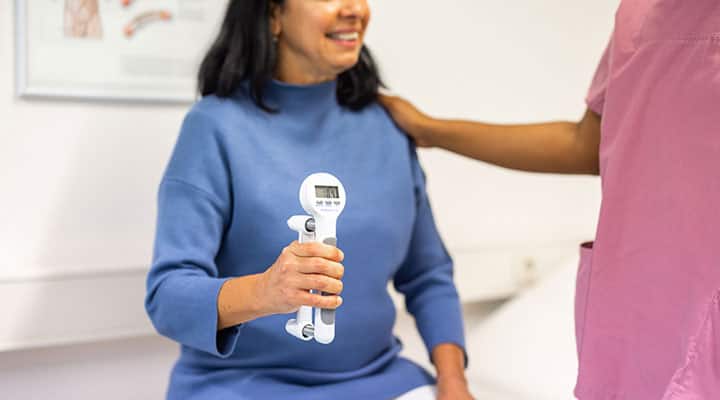
When it comes to proving your grip strength, there's no need to pull a sword out of a stone. Grip strength is all about the numbers, measured in pounds, kilograms or newtons, using a dynamometer.
In older adults, grip strength is increasingly viewed as a vital sign of overall health and function. If it isn't part of your regular assessment, you can always ask your doctor to measure your grip strength at your next visit. Once assessed, compare your grip strength to an age- and sex-specific reference chart. This will give you a good idea as to whether your measures fall within a healthy range.
Also reference your score against the clinical low-strength cutoffs. These thresholds are used to identify possible sarcopenia, an important diagnosis in older populations. For men, the low strength cutoff point is less than 27-29 kg (60-64 lb.). For women, it's less than 16-18 kg (35-40 lb.).
If you find your score is at or above average, you're on track for healthy aging. That's something to celebrate! If your score falls on the lower end, consider it motivation to build your strength. Be sure to consult a healthcare professional if it affects activities of daily living.
What are the best exercises to support grip strength?

We know that movement is essential for healthy aging. Grip strength is no exception. Better yet, the most effective approaches don't have to be complicated: Human studies point to simple movements like squeezing, pulling, carrying and lifting against resistance.
Many exercises include these functions, from dead hangs to dumbbells to carrying groceries. Fortunately, it matters less which exercises you do but rather how you do them.
It all comes down to progressive overload, or regular repetition with increased difficulty. The best exercise is the one you complete most regularly, so have fun with it! Gym-goers may even find that grip-strengthening exercises are already part of their routine. Banded rows, pulldowns, reverse wrist curls, farmer's carries, and dead hangs are all well-supported choices.
While weightlifting comes with additional benefits, direct hand-strength work is also effective. Handgrip devices and therapy putty drills allow you to target the muscles in your hands, wrists and forearms. Plus, you can use them almost anywhere. Who doesn't love a fidget toy?
What nutrients help support healthy muscle strength as you age?

We have all heard the saying "Results start in the kitchen." And it is true: certain nutrients in your diet are known to promote strength, especially with age. They include the following:
Protein
Protein is the MVP of muscle maintenance (and for good reason). This famous macronutrient provides amino acids essential to muscle growth and repair. As such, protein intake should be prioritized, especially in active or aging populations.
Creatine monohydrate
Creatine is one of the most well-studied compounds for supporting both muscle strength and power.
Vitamin D
Vitamin D is known as the sunshine vitamin, but you shouldn't rely on sunlight alone. For strong bones and a strong body, you'll want to focus on vitamin D intake.
Omega-3 fatty acids
Omega-3s are known for supporting whole-body health, including heart health and a healthy inflammatory response. If you need another reason to love them, consider their support for muscle health.
HMB
HMB, or ß-hydroxy-ß-methylbutyrate, is known for its role in muscle preservation, particularly in adults over 65. The "MB" doesn't stand for muscle building, but that's exactly how you should remember it.
| Nutrient | Dosage | Potential benefit |
|---|---|---|
| Protein | About 1.0-1.2 g/kg body weight/day | Provides amino acids needed to maintain and repair muscle. |
| Creatine monohydrate | 3-5 g/day | May support muscle strength, power and exercise performance. |
| Vitamin D | Enough to maintain blood levels of 50-80 ng/mL. Many older adults will require 2,000-5,000 IU daily. |
Supports muscle function, especially if levels are low. Pro tip: Check levels periodically. |
| Omega-3s | 1-4 g/day | May help support muscle health and a healthy inflammatory response. |
| HMB (ß-hydroxy-ß-methylbutyrate monohydrate) | At least 3 g daily | Helps maintain muscle function and support muscle growth, especially for those over 65. |
Pro Tip: It's important to remember that these nutrients can help with grip and muscle strength, but they are not a replacement for resistance training. Your strength journey always starts with movement.
Key Takeaways
- Grip strength may start slipping in your 50s, with menopause bringing a sharper decline for some women.
- To improve grip strength, prioritize regular exercise with increasing intensity.
- Support muscle strength with adequate protein intake and proper fueling.
References
- Akbas A. "Hand-Focused Strength and Proprioceptive Training for Improving Grip Strength and Manual Dexterity in Healthy Adults: A Systematic Review and Meta-Analysis." Journal of Clinical Medicine. September 2025. https://www.mdpi.com/2077-0383/14/19/6882
- Bohannon RW. "Grip Strength: An Indispensable Biomarker For Older Adults." Clin Interv Aging. October 2019. https://pmc.ncbi.nlm.nih.gov/articles/PMC6778477/
- Conole ELS, et al. "Epigenetic clocks and DNA methylation biomarkers of brain health and disease." Nat Rev Neurol. August 2025. https://pubmed.ncbi.nlm.nih.gov/40533525/
- Cruz-Jentoft AJ, et al. "Sarcopenia: revised European consensus on definition and diagnosis." Age Ageing. January 2019. https://pmc.ncbi.nlm.nih.gov/articles/PMC6322506/
- Field AE, et al. "DNA Methylation Clocks in Aging: Categories, Causes, and Consequences." Mol Cell. September 2018. https://pmc.ncbi.nlm.nih.gov/articles/PMC6520108/
- Huebner M, et al. "Sex Differences in Age-Associated Rate of Decline in Grip Strength When Engaging in Vigorous Physical Activity." International Journal of Environmental Research and Public Health. September 2022. https://www.mdpi.com/1660-4601/19/17/11009
- Li GQ, et al. "The intervention effects of resistance exercise on sarcopenia in older adults: a systematic review and meta-analysis." BMC Geriatr. June 2026. https://pubmed.ncbi.nlm.nih.gov/42304276/
- Mayhew AJ, et al. "Normative values for grip strength, gait speed, timed up and go, single leg balance, and chair rise derived from the Canadian longitudinal study on ageing." Age Ageing. April 2023. https://academic.oup.com/ageing/article/52/4/afad054/7127665
- Perna FM, et al. "Muscular Grip Strength Estimates of the U.S. Population from the National Health and Nutrition Examination Survey 2011-2012." J Strength Cond Res. March 2016. https://pmc.ncbi.nlm.nih.gov/articles/PMC7197498/
- Peterson MD, et al. "Grip strength is inversely associated with DNA methylation age acceleration." J Cachexia Sarcopenia Muscle. February 2023. https://pubmed.ncbi.nlm.nih.gov/36353822/
- Rui LH, et al. "Optimal dose of resistance training to improve handgrip strength in older adults with sarcopenia: a systematic review and Bayesian model-based network meta-analysis." Frontiers in Physiology. July 2025. https://www.frontiersin.org/journals/physiology/articles/10.3389/fphys.2025.1564988/full
About Our Story Sources
The Life Extension Health News team delivers accurate information about vitamins, nutrition and aging. Our stories rely on multiple, authoritative sources and experts. We keep our content accurate and trustworthy, by submitting it to a medical reviewer.


