

Life Extension Magazine®

Metformin Slows Aging in Monkeys
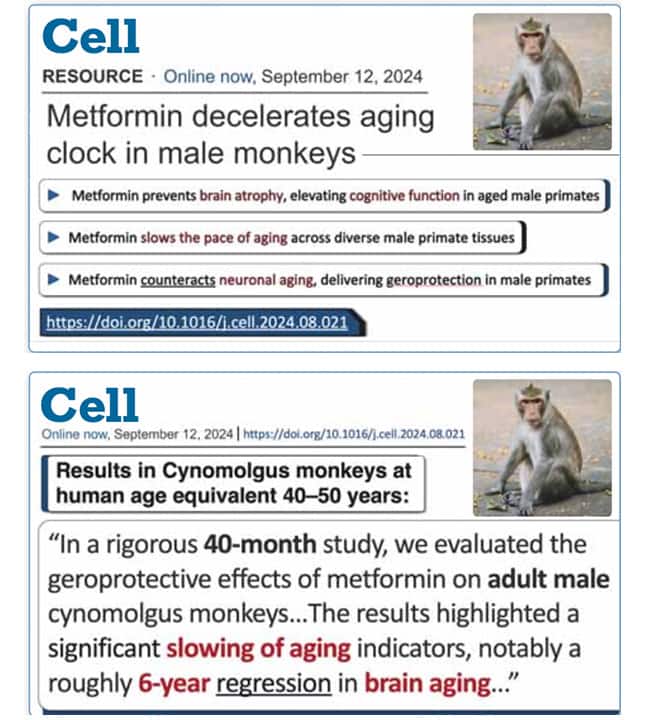
For the first time in a primate model, metformin was found to improve markers of senescence across various body tissues, and regress brain aging by about 6 years compared to controls.
Scientifically reviewed by: Gary Gonzalez, MD, in September 2025. Written by: Brett Chafin.
Life Extension has written about the potential anti-aging benefits of metformin for decades.1-3
A medication used to manage type 2 diabetes, metformin has been shown to slow aging in animals such as worms,4,5 fruit flies,5,6 and rodents.5
Now, in a first-of-its-kind study published in the medical journal Cell, metformin has demonstrated similar effects in male primates, close relatives of humans.7
Several markers of aging were significantly affected, apparently reducing the biological age of aging macaque monkeys.
The effects were particularly striking in the brain: the male monkeys receiving metformin had a brain age (as estimated by a methylation/epigenetic clock) that was nearly six years younger than monkeys that did not receive the drug.7
The metformin-treated monkeys also performed significantly better on tests of cognitive function.
This study adds to the growing evidence that metformin may have significant anti-aging effects.
What is Metformin?
Metformin is a synthetic drug developed from compounds found in an herb known as goat’s rue or French lilac. It has been used in Europe to treat type 2 diabetes since the 1950s and was approved by the U.S. Food & Drug Administration (FDA) in 1994.8
Metformin is the recommended first-line treatment for type 2 diabetes,9 as well as for diabetes prevention in high-risk individuals with prediabetes.10 Metformin may reduce appetite and can lead to modest weight loss,11 but it is not an FDA-approved treatment for obesity, nor is it commonly used for weight loss.
Since metabolic dysfunction is linked to accelerated aging,12,13 metformin has been extensively studied as a potential anti-aging treatment due to its effects on aging-related molecular pathways.4,6,14
Retrospective studies suggest it may reduce mortality and improve survival in patients with type 2 diabetes.15-18 Current and upcoming trials may provide further insight into the anti-aging benefits of metformin in humans.19
In-Depth Primate Study
Metformin’s anti-aging effects had never been evaluated in primates—until now.7 Because they are genetically closer to humans, primate models may offer a more representative view of how anti-aging interventions could affect people.20
Researchers set out to study the effects of metformin in aging male macaque monkeys. Older monkeys were given metformin daily for 40 months (approximately equivalent to more than a decade of human life) and were compared to age-matched controls that did not receive the medication.7
The scientists evaluated multiple markers of aging, including changes in metabolism and gene expression, cellular senescence (when aged cells become dysfunctional), fibrosis, tissue atrophy, and inflammation.7
They used these data to create "aging clocks" that estimate how rapidly an animal is aging. These clocks have been validated in various animal models, as well as in humans, to give estimates of the rate of the aging process.21,22
Slowing the Aging Process
The results of the study provided strong evidence that metformin had an anti-aging effect.7
In tissues throughout the body, markers of aging—including some for cellular senescence, fibrosis, and chronic inflammation—were reduced in the monkeys receiving metformin.
Models of aging that included metabolic, protein, genetic, and epigenetic data also showed changes that indicated a slower progression of aging in the treated monkeys.7
For example, DNA methylation clocks are a measure of chemical changes in genetic material that occur over time. They have been found to be a reliable marker of aging across various species, including humans.21,22 The researchers created a special DNA methylation clock to estimate biological age across multiple organs in monkeys and used it to assess the effects of metformin.7
In this study, the DNA methylation age of several organs, including the kidneys, lungs, and liver, was reduced in the metformin group. The DNA methylation age of the brains of monkeys receiving metformin was about six years younger than that of untreated animals.
The researchers also developed their own novel monkey aging clock that incorporated metabolic, protein, and gene expression data along with the DNA methylation data. This clock found that the treated animals had a "biological age" that was significantly younger than the non-treated monkeys.
Metformin also slowed structural changes associated with aging, reducing both periodontal bone loss and atrophy of the frontal lobes of the brain.
The study also showed that these cellular and tissue changes correlated with improved function. Monkeys receiving metformin performed significantly better on tasks that evaluate cognitive functions like learning and memory than monkeys that did not receive metformin.
How It Works
While this study was not designed to fully evaluate how metformin exerts its anti-aging effects, the researchers found evidence that it enhances the activity of Nrf2, a protein that protects against damaging oxidative stress.7
Although not evaluated in this study, compounds such as sulforaphane, curcumin, resveratrol, and apigenin have demonstrated Nrf2-activating properties in laboratory models23 —a pathway that metformin has also appeared to influence.
Previous studies have focused on the possibility that metformin may activate the protein AMPK,24 part of a metabolic "switch" that shifts the body’s energy metabolism pathways.
Many other molecular and biological pathways affected by metformin have been suggested to account, at least in part, for its observed benefits. Through these various mechanisms, it is believed that metformin may act as a whole-body anti-aging drug.7,25
Summary
Metformin is a drug used to treat type 2 diabetes and related conditions. It is increasingly being studied as an anti-aging intervention.
A new study has evaluated metformin as an anti-aging drug in a primate model for the first time.
In male macaque monkeys, metformin was found to slow the aging process.
Multiple markers of aging across various body tissues were improved in monkeys receiving metformin, slowing their "aging clocks." Brain function was also improved in the monkeys receiving metformin.
Further studies will be required to confirm these benefits in humans. But this breakthrough primate study highlights metformin’s potential to slow aging, ward off age-related loss of function, and improve health throughout the body. •
If you have any questions on the scientific content of this article, please call a Life Extension Wellness Specialist at 1-866-864-3027.
References
- Available at: /magazine/2001/9/awsi. Accessed July 22, 2025.
- Available at: /magazine/2016/3/anti-aging-human-study-on-metformin-wins-fda-approval. Accessed July 22, 2025.
- Available at: /magazine/2017/4/metformin-slashes-cancer-risks. Accessed July 22, 2025.
- Zhang T, Zhou L, Makarczyk MJ, et al. The Anti-Aging Mechanism of Metformin: From Molecular Insights to Clinical Applications. Molecules. 2025 Feb 10;30(4).
- Kulkarni AS, Gubbi S, Barzilai N. Benefits of Metformin in Attenuating the Hallmarks of Aging. Cell Metab. 2020 Jul 7;32(1):15-30.
- Mohammed I, Hollenberg MD, Ding H, et al. A Critical Review of the Evidence That Metformin Is a Putative Anti-Aging Drug That Enhances Healthspan and Extends Lifespan. Front Endocrinol (Lausanne). 2021;12:718942.
- Yang Y, Lu X, Liu N, et al. Metformin decelerates aging clock in male monkeys. Cell. 2024 Oct 31;187(22):6358-78 e29.
- Bailey CJ. Metformin: historical overview. Diabetologia. 2017 Sep;60(9):1566-76.
- American Diabetes Association Professional Practice C. 9. Pharmacologic Approaches to Glycemic Treatment: Standards of Care in Diabetes-2025. Diabetes Care. 2025 Jan 1;48(1 Suppl 1):S181-S206.
- American Diabetes Association Professional Practice C. 3. Prevention or Delay of Diabetes and Associated Comorbidities: Standards of Care in Diabetes-2025. Diabetes Care. 2025 Jan 1;48(1 Suppl 1):S50-S8.
- Yerevanian A, Soukas AA. Metformin: Mechanisms in Human Obesity and Weight Loss. Curr Obes Rep. 2019 Jun;8(2):156-64.
- Zhang Z, He X, Sun Y, et al. Type 2 Diabetes Mellitus: A Metabolic Model of Accelerated Aging - Multi-Organ Mechanisms and Intervention Approaches. Aging Dis. 2025 May 23.
- McCarthy K, O’Halloran AM, Fallon P, et al. Metabolic syndrome accelerates epigenetic ageing in older adults: Findings from The Irish Longitudinal Study on Ageing (TILDA). Exp Gerontol. 2023 Nov;183:112314.
- Chen S, Gan D, Lin S, et al. Metformin in aging and aging-related diseases: clinical applications and relevant mechanisms. Theranostics. 2022;12(6):2722-40.
- Bannister CA, Holden SE, Jenkins-Jones S, et al. Can people with type 2 diabetes live longer than those without? A comparison of mortality in people initiated with metformin or sulphonylurea monotherapy and matched, non-diabetic controls. Diabetes Obes Metab. 2014 Nov;16(11):1165-73.
- Campbell JM, Bellman SM, Stephenson MD, et al. Metformin reduces all-cause mortality and diseases of ageing independent of its effect on diabetes control: A systematic review and meta-analysis. Ageing Res Rev. 2017 Nov;40:31-44.
- Campisi J, Kapahi P, Lithgow GJ, et al. From discoveries in ageing research to therapeutics for healthy ageing. Nature. 2019 Jul;571(7764):183-92.
- Yen FS, Chen W, Wei JC, et al. Effects of metformin use on total mortality in patients with type 2 diabetes and chronic obstructive pulmonary disease: A matched-subject design. PLoS One. 2018;13(10):e0204859.
- Available at: https://clinicaltrials.gov/search?cond=Aging&term=Healthy%20Aging&intr=metformin. Accessed July 23, 2025.
- Colman RJ. Non-human primates as a model for aging. Biochim Biophys Acta Mol Basis Dis. 2018 Sep;1864(9 Pt A):2733-41.
- Singh PP, Demmitt BA, Nath RD, et al. The Genetics of Aging: A Vertebrate Perspective. Cell. 2019 Mar 21;177(1):200-20.
- He X, Liu J, Liu B, et al. The use of DNA methylation clock in aging research. Exp Biol Med (Maywood). 2021 Feb;246(4): 436-46.
- Thiruvengadam M, Venkidasamy B, Subramanian U, et al. Bioactive Compounds in Oxidative Stress-Mediated Diseases: Targeting the NRF2/ARE Signaling Pathway and Epigenetic Regulation. Antioxidants (Basel). 2021 Nov 23;10(12).
- Triggle CR, Mohammed I, Bshesh K, et al. Metformin: Is it a drug for all reasons and diseases? Metabolism. 2022 Aug;133:155223.
- Petsouki E, Cabrera SNS, Heiss EH. AMPK and NRF2: Interactive players in the same team for cellular homeostasis? Free Radic Biol Med. 2022 Sep;190:75-93.


Wellness
Specialists
1-800-226-2370 - This service is FREE
7:30 AM - 12 AM (ET) Mon-Fri | 9 AM - 12 AM (ET) Sat-Sun