




Life Extension Magazine.

As We See It: Tribute to A Life-Saving Pioneer
When Harvard scientist Kilmer McCully identified elevated homocysteine as a cardiovascular risk factor, his findings were rejected for many years.
By William Faloon.

The New York Times headline read:1
"Kilmer McCully, 91, Dies, Pathologist Vindicated on Heart Disease Theory"
"His studies showed that a B vitamin deficiency could cause hardened arteries. It took the medical profession more than a decade to catch up."
Dr. McCully was a pathologist at Harvard Medical School who became famous, then infamous, and finally vindicated for his discovery that elevated homocysteine is a risk factor for cardiovascular diseases.1
For relentlessly advocating for lower homocysteine levels, his colleagues banished him to the basement, burying his theory for many years.1
Not accepting Dr. McCully’s theory may have cost countless lives. Simple solutions can lower homocysteine and help reduce cardio- vascular risks. Still, most physicians today debate the value of homocysteine blood testing.
Kilmer McCully passed away on February 21, 2025, at the age of 91 from metastatic prostate cancer.1
The irony of this is that both homocysteine and PSA (prostate specific antigen) can be tested in blood and offer a chance to take corrective actions before serious diseases manifest.
We published an article about the science supporting Dr. McCully’s homocysteine hypothesis in 1981 and suggested our readers initiate steps to lower this atherogenic compound if elevated.2
This editorial is a tribute to Dr. McCully’s pioneering research and describes strategies to reduce homocysteine, including a surprising method to optimize even stubbornly high homocysteine blood levels.
What is Homocysteine?
Homocysteine is an amino acid formed in the body from intake of another amino acid called methionine, which is high in certain meats and dairy products.3
High levels of homocysteine are associated with a range of diseases including Alzheimer’s,4,5 migraines,6 hearing loss, 7 cerebrovascular,8 and cardiovascular diseases.9,10
Data going back many decades indicated a value in testing homocysteine levels as part of a comprehensive cardiovascular risk assessment.
Yet despite published evidence, most doctors still ignore this marker—potentially leaving some of their patients vulnerable to preventable cardiovascular disorders, including ischemic stroke.
Multiple B vitamins play a role in breaking down homocysteine.11-13 Deficiency in these vitamins can result in elevated homocysteine levels.14
Dr. McCully’s Discoveries
Homocystinuria (very high urine and plasma homocysteine levels) is a rare genetic disorder that results in early-age onset vascular disease.15 In a case-series study of homocystinuria, a nine-year-old girl died from a stroke just like her uncle did at the age of eight.1
Hearing about this in the late 1960’s, McCully tracked down the autopsy reports from these children which revealed hardened arteries but no cholesterol or fat in the plaque buildup.1
McCully ran experiments in rabbits which showed that injecting high doses of homocysteine led to moderate thickening in all their aortas. Upon further research he found that vitamins B6 and B12 helped lower homocysteine levels. When presenting his findings to the medical establishment, however, they were not motivated to take any action.1
McCully’s theory on homocysteine was ignored until the 1990s when large-scale studies led by other researchers produced results that supported his theories.
The famous Framingham Heart Study found that hardening of the arteries connected to the brain was associated with elevated homocysteine levels.16
Another study by authors that included researchers from the Harvard School of Public Health found that men with the highest levels of homocysteine had a three-fold greater risk of suffering a heart attack than men with lower levels.17
Regarding McCully’s theory, an epidemiologist who helped lead the study that found men with high homocysteine levels faced triple the heart attack risk said:
"At the end of the day, he was right in the sense that homocysteine is a marker for higher risk for cardiovascular disease and he gets the credit for developing this theory and helping to provide the evidence for it."1
Who is Most At Risk of High Homocysteine?
In 1998, the United States and Canada made it mandatory to fortify foods like cereal, flour, and bread with folate primarily to reduce the risk of neural tube defects, but it has also helped bring homocysteine down to healthy levels in many people.18,19
An interesting study compared the changes in stroke mortality during and after folate fortification in the U.S. and Canada to England and Wales (countries without folate fortification). From 1990 to 2002, all populations experienced a decline in stroke mortality. However, when the U.S. and Canada fortified their food with folate the stroke death decline accelerated faster compared to England and Wales.20
Post fortification, between 1999-2002, the mean levels of homocysteine amongst Americans declined to around 8-9 µmol/L.21,22 This was also the last time the average homocysteine level in the American population was evaluated that we could find.
We at Life Extension® recommend keeping homocysteine levels below 12 µmol/L, with under 8 µmol/L as the optimal target.
For those whose homocysteine levels are now in safe ranges because of fortification and increased use of folate-containing supplements, there is little to be concerned about.
Certain individuals, however, remain challenged with stubbornly high homocysteine levels.
Homocysteine is generally higher in men than women, with age, and in association with certain diseases such as chronic kidney disease, heart failure, dementia, and diabetes. Those hospitalized with these conditions frequently present with elevated homocysteine blood levels.23-25
Elevated homocysteine may also arise from mutations in genes that code for enzymes involved in the metabolism of methionine, including the MTHFR gene.26
These MTHFR genetic variants leave more folate in a less bioactive state due to inefficient methylation. Since the fortification of the food supply with folate, only about 12% of those with the worst genetic variant of MTHFR have elevated homocysteine, compared to 33% pre-fortification.27
The only way to know your homocysteine level is with blood testing, and if elevated it can easily be reduced to better support cardiovascular health.
A Norwegian study of about 5,000 adults (ages 65–67), found that compared to those below 9 µmol/L, individuals with levels between 9–11.9 µmol/L had a 30% higher risk of cardiovascular death and 40% higher risk of non-cardiovascular death. Those with levels between 12–14.9 µmol/L faced a 110% and 90% increased risk, respectively.28
Lower Homocysteine Connected To Mediterranean Diet’s Benefits
A study published in JAMA in 2024 analyzed the biomarkers of about 25,000 women in connection with their adherence to a Mediterranean diet and health outcomes over the course of 25 years.29
Over the course of follow up, 3,879 deaths occurred. Those who had the greatest adherence to the Mediterranean diet had an 11% lower risk of mortality compared with those who had the lowest adherence after adjusting for lifestyle factors.
They also found that reduced homocysteine and inflammation explained some of the largest contributions to the lower mortality risk in people with the highest adherence to the Mediterranean diet.
Simply stated, reduced death risks were associated with lower homocysteine and other factors as you can see by the chart below:
Reduced Death Risks Were Associated with:
- Lower homocysteine, triglycerides (other lipids)
- Lower C-reactive protein (other inflammatory markers)
- Lower creatinine (kidneys)
- Lower insulin resistance (diabetic markers)
- Lower body mass
- Higher alanine & citrate (mitochondria & protein synthesis)
Why Some Researchers Question The Benefits of Reducing Homocysteine

The cause of plaque build-up in the arteries will vary from individual to individual.
Including homocysteine testing in cardiovascular risk assessment could save many lives and much grief. Some clinical trials fail to show a benefit from homo- cysteine reduction alone; we believe this is because they fail to consider all the other risk factors for cardio- vascular disease.
There are 20 or more independent risk factors for cardiovascular disease. Targeting one without the others will not accomplish ideal disease prevention.30,31
High plasma levels of homocysteine may further exacerbate damage to the inner lining of the blood vessels, called the endothelium, when combined with high LDL, glucose, and hypertension.9
How To Reduce Elevated Homocysteine
High homocysteine levels can be easily reversed by increasing intake of certain B vitamins such as vitamins B6, B12 (methylcobalamin) and folate (5-methyl-tetrahydrofolate) and reducing intake of methionine.32,33
One overlooked approach to lowering homo- cysteine further is with high doses (around 1,800 mg/day) of N-acetyl-cysteine (NAC), which may help detoxify homocysteine via another mechanism.
It is believed that NAC’s supplying of abundant cysteine into the bloodstream causes displacement of homocysteine from its binding to albumin in plasma, freeing it to then be cleared by the kidneys.34
Summary
We at Life Extension® have alerted the public about the potential dangers of excess homocysteine since 1981, echoing Dr. McCully’s work.
Unfortunately, most blood test panels that screen for cardiovascular disease still omit homocysteine when convincing evidence suggests that homocysteine testing and treatment may save lives.
As we honor Dr. McCully, let us not repeat the mistakes of the past. Let’s ensure that homocysteine is no longer overlooked in the prevention of cardiovascular diseases.
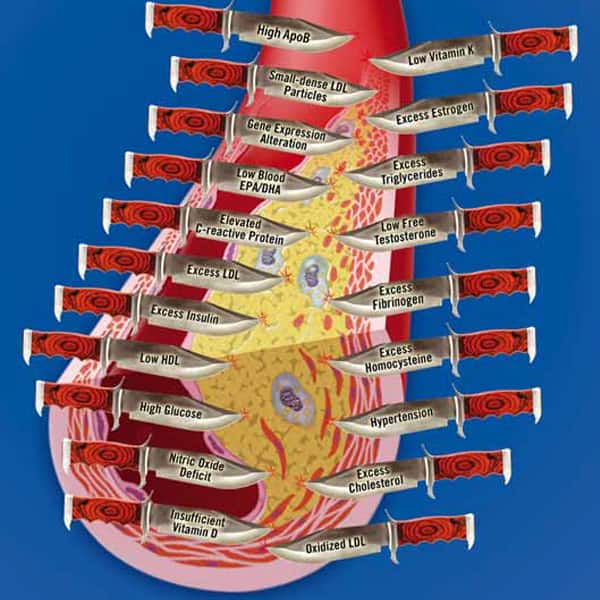
20 Daggers of Arterial Disease
This graphic shows 20 daggers aimed at an artery occluded with atherosclerotic plaque.
Any one of these "daggers" can initiate and propagate atherosclerotic vascular disease.
Most readers of this magazine are aware of the pathologies involved in arterial disease and follow comprehensive preventive measures.
For longer life,

William Faloon, Co-Founder, Life Extension®
References
- Available at: https://www.nytimes.com/2025/03/21/science/kilmer-mccully-dead.html. Accessed August 12, 2025.
- Available at: https://www.lifeextension.com/about/life-extension-story/track-record#1980s. Accessed August 12, 2025.
- Nuru M, Muradashvili N, Kalani A, et al. High methionine, low folate and low vitamin B6/B12 (HM-LF-LV) diet causes neurodegeneration and subsequent short-term memory loss. Metab Brain Dis. 2018 Dec;33(6):1923-34.
- Smith AD, Refsum H, Bottiglieri T, et al. Homocysteine and Dementia: An International Consensus Statement. J Alzheimers Dis. 2018;62(2):561-70.
- Zuin M, Cervellati C, Brombo G, et al. Elevated Blood Homocysteine and Risk of Alzheimer’s Dementia: An Updated Systematic Review and Meta-Analysis Based on Prospective Studies. J Prev Alzheimers Dis. 2021 2021/07/01/;8(3):329-34.
- Liampas I, Siokas V, Mentis AA, et al. Serum Homocysteine, Pyridoxine, Folate, and Vitamin B12 Levels in Migraine: Systematic Review and Meta-Analysis. Headache. 2020 Sep;60(8):1508-34.
- Gopinath B, Flood VM, Rochtchina E, et al. Serum homocysteine and folate concentrations are associated with prevalent age-related hearing loss. J Nutr. 2010 Aug;140(8):1469-74.
- Rabelo NN, Telles JPM, Pipek LZ, et al. Homocysteine is associated with higher risks of ischemic stroke: A systematic review and meta-analysis. PLoS One. 2022;17(10):e0276087.
- Jakubowski H, Witucki L. Homocysteine Metabolites, Endothelial Dysfunction, and Cardiovascular Disease. Int J Mol Sci. 2025 Jan 16;26(2).
- Martinez-Vega R, Garrido F, Partearroyo T, et al. Folic acid deficiency induces premature hearing loss through mechanisms involving cochlear oxidative stress and impairment of homocysteine metabolism. FASEB J. 2015 Feb;29(2):418-32.
- Fratoni V, Brandi ML. B vitamins, homocysteine and bone health. Nutrients. 2015 Mar 30;7(4):2176-92.
- Kataria N, Yadav P, Kumar R, et al. Effect of Vitamin B6, B9, and B12 Supplementation on Homocysteine Level and Cardiovascular Outcomes in Stroke Patients: A Meta-Analysis of Randomized Controlled Trials. Cureus. 2021 May 11;13(5):e14958.
- Hankey GJ. B vitamins for stroke prevention. Stroke Vasc Neurol. 2018 Jun;3(2):51-8.
- Zaric BL, Obradovic M, Bajic V, et al. Homocysteine and Hyperhomocysteinaemia. Curr Med Chem. 2019;26(16):2948-61.
- Gerrard A, Dawson C. Homocystinuria diagnosis and management: it is not all classical. J Clin Pathol. 2022 Sep 19.
- Selhub J, Jacques PF, Bostom AG, et al. Relationship between plasma homocysteine, vitamin status and extracranial carotid-artery stenosis in the Framingham Study population. J Nutr. 1996 Apr;126(4 Suppl):1258S-65S.
- Stampfer MJ, Malinow MR, Willett WC, et al. A prospective study of plasma homocyst(e)ine and risk of myocardial infarction in US physicians. JAMA. 1992 Aug 19;268(7):877-81.
- Ismail S, Eljazzar S, Ganji V. Intended and Unintended Benefits of Folic Acid Fortification-A Narrative Review. Foods. 2023 Apr 11;12(8):1612.
- Available at: https://www.health.harvard.edu/womens-health/the-ups-and-downs-of-folic-acid-fortification. Accessed August 6, 2025.
- Yang Q, Botto LD, Erickson JD, et al. Improvement in stroke mortality in Canada and the United States, 1990 to 2002. Circulation. 2006 Mar 14;113(10):1335-43.
- Ganji V, Kafai MR. Population reference values for plasma total homocysteine concentrations in US adults after the fortification of cereals with folic acid. Am J Clin Nutr. 2006 Nov;84(5):989-94.
- Ganji V, Kafai MR. Trends in serum folate, RBC folate, and circulating total homocysteine concentrations in the United States: analysis of data from National Health and Nutrition Examination Surveys, 1988-1994, 1999-2000, and 2001-2002. J Nutr. 2006 Jan;136(1):153-8.
- Rader JI. Folic acid fortification, folate status and plasma homocysteine. J Nutr. 2002 Aug;132(8 Suppl):2466S-70S.
- Marengoni A, Cossi S, De Martinis M, et al. Homocysteine and disability in hospitalized geriatric patients. Metabolism. 2004 Aug;53(8):1016-20.
- Rodriguez JJ, Santolaria F, Martinez-Riera A, et al. Clinical significance of homocysteine in elderly hospitalized patients. Metabolism. 2006 May;55(5):620-7.
- Zarembska E, Slusarczyk K, Wrzosek M. The Implication of a Polymorphism in the Methylenetetrahydrofolate Reductase Gene in Homocysteine Metabolism and Related Civilisation Diseases. Int J Mol Sci. 2023 Dec 22;25(1).
- Tsai MY, Loria CM, Cao J, et al. Clinical utility of genotyping the 677C>T variant of methylenetetrahydrofolate reductase in humans is decreased in the post-folic acid fortification era. J Nutr. 2009 Jan;139(1):33-7.
- Vollset SE, Refsum H, Tverdal A, et al. Plasma total homocysteine and cardiovascular and noncardiovascular mortality: the Hordaland Homocysteine Study. Am J Clin Nutr. 2001 Jul;74(1):130-6.
- Ahmad S, Moorthy MV, Lee IM, et al. Mediterranean Diet Adherence and Risk of All-Cause Mortality in Women. JAMA Netw Open. 2024 May 1;7(5):e2414322.
- Arnett DK, Blumenthal RS, Albert MA, et al. 2019 ACC/AHA Guideline on the Primary Prevention of Cardiovascular Disease: Executive Summary: A Report of the American College of Cardiology/American Heart Association Task Force on Clinical Practice Guidelines. J Am Coll Cardiol. 2019 Sep 10;74(10):1376-414.
- Available at: https://www.heart.org/en/health-topics/heart-attack/understand-your-risks-to-prevent-a-heart-attack. Accessed August 6, 2025.
- Fezeu LK, Ducros V, Gueant JL, et al. MTHFR 677C --> T genotype modulates the effect of a 5-year supplementation with B-vitamins on homocysteine concentration: The SU.FOL.OM3 randomized controlled trial. PLoS One. 2018;13(5):e0193352.
- Hustad S, Midttun O, Schneede J, et al. The methylenetetrahydrofolate reductase 677C-->T polymorphism as a modulator of a B vitamin network with major effects on homocysteine metabolism. Am J Hum Genet. 2007 May;80(5):846-55.
- Hildebrandt W, Sauer R, Bonaterra G, et al. Oral N-acetylcysteine reduces plasma homocysteine concentrations regardless of lipid or smoking status. Am J Clin Nutr. 2015 Nov;102(5):1014-24.


Wellness
Specialists
1-800-226-2370 - This service is FREE
7:30 AM - 12 AM (ET) Mon-Fri | 9 AM - 12 AM (ET) Sat-Sun