



Life Extension Magazine®

Anti-Aging Research Advances
A remarkable number of healthy-longevity findings have been published over the past 18 months.
By William Faloon.

A remarkable number of healthy-longevity findings have been published over the past 18 months.
I presented much of this data at a scientific conference in July 2025. The audience was thrilled to learn how close we may be to significantly extending our lifespans.
In upcoming issues of Life Extension Magazine I will provide easy-to-understand advances rapidly occurring in the regenerative medicine arena.
The good news is that scientists are further validating much of what most of you do now to live longer.
And the progress being made in the fields of age-delay and age-reversal gives us all hope of longevity enhancements that were previously unimaginable.
Our regenerative research projects are funded solely from proceeds of blood tests and nutritional supplements you obtain from us.
Unlike early decades (1970s-1990s) when we were ridiculed for suggesting humans could live much longer, the most influential people today are also pursuing initiatives to restore youthful functionality to our aged bodies.
In preclinical studies, a plant extract called luteolin has demonstrated potential to fight the aging process.1-3
As you will learn on the next page, a more bioavailable form of luteolin may enable greater systemic effects.
My gratitude to Life Extension supporters who enable us to fund pioneering projects aimed at whole-body rejuvenation.
Luteolin and Cellular Integrity
Luteolin is a polyphenol found in foods such as fruits, flowers, and herbs.4
It was identified by Life Extension® in 1985 and made available as part of a multi-ingredient formula shortly after.
Luteolin may exert its anti-aging benefits by modulating autophagy,3,5 aka cellular housekeeping, or the body’s ability to remove intracellular waste products.6
With age, the cell’s ability to clear out its damaged components declines. This results in the accumulation of debris inside our cells that interferes with healthy function.7
Autophagy deficits have been implicated in neurodegenerative disorders, cardiovascular diseases, cancer, and more.7,8
Luteolin boosts autophagy and may also engage the molecular machinery that improves mitophagy, which is the selective removal of degraded or damaged mitochondria.9
Boosting autophagy and mitophagy has been shown to increase or extend lifespan in yeast, nematodes, fruit flies, and mice.10
It may do the same in humans.
Preclinical research suggests that luteolin may provide some protective effects against the following conditions:
- Cancer (liver, breast, lung, GI, bladder, pancreatic)4,11,12
- Cardiovascular/Atherosclerosis4
- Obesity4
- Insulin Resistance11,13
- Liver disorders4
- Kidney disorders4
- Brain injury14
- Neurodegenerative disorders4,15
- Asthma4,11,16,17
- Gastrointestinal (GI) disorders4,18
- Depression19
The question is whether this preclinical evidence translates into real-world benefits for aging humans.
This growing body of data on luteolin has spurred increasing interest from the scientific community. A search for "luteolin" in titles on the National Library of Medicine (PubMed) returns over 1,300 new results, with exponentially greater results since the year 2009.
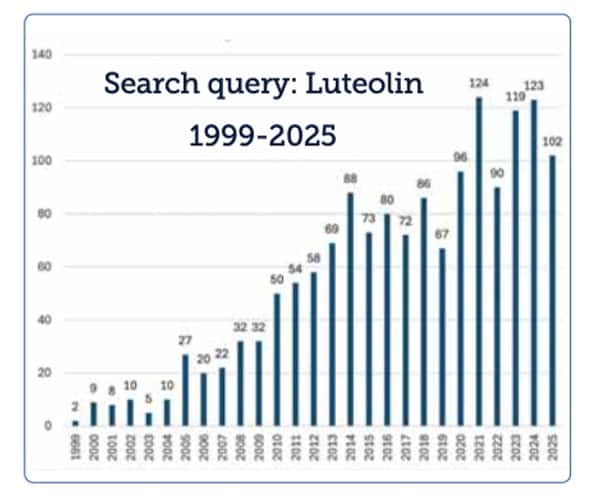
Luteolin Research20
The major dilemma with luteolin has been its poor bioavailability.
In an artificial environment, like a cell culture, luteolin can reach and penetrate cells, but it doesn’t do this well when ingested orally. In animal research, its bioavailability is around 26%.21
Researchers have found that the bioavailability can be enhanced significantly when luteolin is combined with fibers from the fenugreek plant.
In fact, in a human trial, this formulated luteolin achieved "nearly 14" times greater bioavailability than an unformulated version.22
Thanks to this bioavailability enhancement, some of the benefits of luteolin observed in preclinical studies may now be replicated in humans.
Higher dosages around 500 mg have been clinically shown to improve testosterone and libido in men, but lower dosages with higher bioavailability may be all that’s needed to provide benefits for men and women without affecting sex hormones.22 (More on this will be published in a future issue of Life Extension® Magazine.)

Summary
The longevity sciences are advancing at a rapid pace.
Our supporters take advantage of interventions available today to live long enough to benefit from discoveries that have already occurred in the laboratory.
This may soon include cellular reprogramming that has reversed certain molecular and physiological hallmarks of aging in mice.
We at Life Extension® are now testing this in aged monkeys. (Look forward to research updates on this primate study in future issues of Life Extension magazine.)
In the meantime, I am adding 100 mg/day of bioavailable luteolin to my personal program based on evidence that it may help protect against a range of degenerative processes.
Summary of Noteworthy Preclinical Research Findings on LUTEOLIN
Cardiovascular
- Exerted anti-fibrotic effects in the heart. Fibrosis is the thickening and scarring of connective tissue that inflicts tissue damage and loss of function.23
- Inhibited platelet activation, oxidative stress, and thrombosis in human platelets.24
- Restored nitric oxide production and supported vascular function in mice with diet-induced obesity.25
- Promoted autophagy and cleared out intracellular cholesterol from macrophages, preventing them from turning into pro-atherogenic foam cells, which contributes to the clogging of arteries that causes heart disease.26
- Reduced cardiac damage caused by hyper- lipidemia in rats.27
Cancer
- Favorably regulated signaling pathways that suppress cancer cell survival and proliferation.28
- Sensitized tumors to chemotherapeutic agents such as cisplatin, oxaliplatin, doxorubicin, and Taxol, while potentially reducing their toxicity.29,30
- Disrupted cancer cells’ adaptation to hypoxia, limiting their ability to survive in low-oxygen environments.31
- Had anti-inflammatory activity in keratinocytes (primary cells in the outer skin layer) and fibroblasts (most common cells of connective tissue) as well as several immune cells.32
- In plants, flavonoids protect against UV radiation.
Brain Health and Cognition
- Inhibited amyloid-beta (protein associated with Alzheimer’s), induced cell death and oxidative stress.33
- Suppressed the neuroinflammatory response from microglia (immune cells of the brain) and astrocytes (helper cells of neurons).14
- Protected against glutamate-induced neuronal cell death by regulating autophagy and mitochondrial dynamics,9 and it may promote the growth of new astrocytes.34
- Glutamate is an excitatory neurotransmitter; in excessive amounts it can negatively impact neuronal health and contribute to brain injury.
Obesity and Insulin Resistance
- Luteolin improved insulin resistance, suppressed obesity, and reduced inflammatory macrophage infiltration in mice fed a high-fat diet.13
- Upregulated the expression of genes controlling lipolysis (the breakdown of fat).35
Autoimmune
- Regulated macrophage oxidative stress, which may improve symptoms associated with lupus.36
- Inhibited mast cells as well as mast cell-dependent T cell activation which is implicated in multiple sclerosis pathogenesis.15
- Mast cells play a pro-inflammatory and modulatory role in the pathogenesis of multiple sclerosis.
Kidney
- Delayed the progression of IgA nephropathy (the main cause of end stage kidney disease) by attenuating inflammation, oxidative stress, and reducing extracellular matrixaccumulation.37
- Improved renal function in rats with renal injury by reducing oxidative stress, neutrophil infiltration, inflammation, and renal cell apoptosis.38
Liver
- Reduced liver lesions (abnormal growth) through various mechanisms including inhibiting inflammatory factors, reducing oxidative stress, regulating lipid balance, slowing down aggregation of extracellular matrix, and induced both apoptosis and autophagy in liver cells.39
- Relieved metabolic dysfunction-associated fatty liver disease in rats caused by high-fat diets and reduced levels of markers of oxidative stress.18
GI Disorders
- Reduced the incidence of colitis in a mouse model of disease and demonstrated anti-inflammatory activity.40
- Alleviated ulcerative colitis by restoring intestinal barrier integrity and inhibiting pro-inflammatory cytokine production in colonic tissues.40
Asthma
- Attenuated airway inflammation, hyperresponsiveness, and mucus production in experimental asthma models.17
Depression
- Ameliorated chronic stress-induced depressive-like behaviors in mice.19
Clinical trials urgently needed to see if these laboratory findings translate into people.
For longer life,

William Faloon, Co-Founder, Life Extension®
References
- Younis RL, El-Gohary RM, Ghalwash AA, et al. Luteolin Mitigates D-Galactose-Induced Brain Ageing in Rats: SIRT1-Mediated Neuroprotection. Neurochem Res. 2024 Oct;49(10):2803-20.
- Sharma A, Ojha A, Rathee S, et al. Exploring the Therapeutic Potential of Plant-Based Natural Products in Combating Aging. Curr Drug Targets. 2025 Sep 16.
- Brimson JM, Prasanth MI, Malar DS, et al. Plant Polyphenols for Aging Health: Implication from Their Autophagy Modulating Properties in Age-Associated Diseases. Pharmaceuticals (Basel). 2021 Sep 27;14(10).
- Zhu M, Sun Y, Su Y, et al. Luteolin: A promising multifunctional natural flavonoid for human diseases. Phytother Res. 2024 Jul;38(7):3417-43.
- Ponce-Mora A, Salazar NA, Domenech-Bendana A, et al. Interplay Between Polyphenols and Autophagy: Insights From an Aging Perspective. Front Biosci (Landmark Ed). 2025 Mar 19;30(3):25728.
- Shabkhizan R, Haiaty S, Moslehian MS, et al. The Beneficial and Adverse Effects of Autophagic Response to Caloric Restriction and Fasting. Adv Nutr. 2023 Sep;14(5):1211-25.
- Tabibzadeh S. Role of autophagy in aging: The good, the bad, and the ugly. Aging Cell. 2023 Jan;22(1):e13753.
- Klionsky DJ, Petroni G, Amaravadi RK, et al. Autophagy in major human diseases. EMBO J. 2021 Oct 1;40(19):e108863.
- Vongthip W, Nilkhet S, Boonruang K, et al. Neuroprotective mechanisms of luteolin in glutamate-induced oxidative stress and autophagy-mediated neuronal cell death. Sci Rep. 2024 Apr 2;14(1):7707.
- Hansen M, Rubinsztein DC, Walker DW. Autophagy as a promoter of longevity: insights from model organisms. Nat Rev Mol Cell Biol. 2018 Sep;19(9):579-93.
- Rakoczy K, Kaczor J, Soltyk A, et al. Application of Luteolin in Neoplasms and Nonneoplastic Diseases. Int J Mol Sci. 2023 Nov 6;24(21).
- Imran M, Rauf A, Abu-Izneid T, et al. Luteolin, a flavonoid, as an anticancer agent: A review. Biomed Pharmacother. 2019 Apr;112:108612.
- Zhang L, Han YJ, Zhang X, et al. Luteolin reduces obesity-associated insulin resistance in mice by activating AMPKalpha1 signalling in adipose tissue macrophages. Diabetologia. 2016 Oct;59(10):2219-28.
- Kempuraj D, Thangavel R, Kempuraj DD, et al. Neuroprotective effects of flavone luteolin in neuroinflammation and neurotrauma. Biofactors. 2021 Mar;47(2):190-7.
- Theoharides TC. Luteolin as a therapeutic option for multiple sclerosis. J Neuroinflammation. 2009 Oct 13;6:29.
- Aziz N, Kim MY, Cho JY. Anti-inflammatory effects of luteolin: A review of in vitro, in vivo, and in silico studies. J Ethnopharmacol. 2018 Oct 28;225:342-58.
- Huang X, Yu H, Zhou Y, et al. Luteolin attenuates type 2 inflammation in asthmatic mice induced by OVA by regulating IL-33/ST2- GSK3beta-M2 macrophage polarization. Mol Immunol. 2025 Oct;186:1-12.
- Taweesap P, Potue P, Khamseekaew J, et al. Luteolin Relieves Metabolic Dysfunction-Associated Fatty Liver Disease Caused by a High-Fat Diet in Rats Through Modulating the AdipoR1/AMPK/PPARgamma Signaling Pathway. Int J Mol Sci. 2025 Apr 17;26(8).
- Yuan NJ, Zhu WJ, Ma QY, et al. Luteolin ameliorates chronic stress-induced depressive-like behaviors in mice by promoting the Arginase-1(+) microglial phenotype via a PPARgamma-dependent mechanism. Acta Pharmacol Sin. 2025 Mar;46(3):575-91.
- Available at: https://pubmed.ncbi.nlm.nih.gov/?term=luteolin%5Btitle%5D&filter=hum_ani.humans&filter=hum_ani.animal&timeline=expanded. Accessed October 9, 2025.
- Lin LC, Pai YF, Tsai TH. Isolation of Luteolin and Luteolin-7-O-glucoside from Dendranthema morifolium Ramat Tzvel and Their Pharmacokinetics in Rats. J Agric Food Chem. 2015 Sep 9;63(35):7700-6.
- Data On File. Supplier Internal Study; 2024.
- Nakayama A, Morita H, Nakao T, et al. A Food-Derived Flavonoid Luteolin Protects against Angiotensin II-Induced Cardiac Remodeling. PLoS One. 2015;10(9):e0137106.
- Ye Y, Yang L, Leng M, et al. Luteolin inhibits GPVI-mediated platelet activation, oxidative stress, and thrombosis. Front Pharmacol. 2023;14:1255069.
- Gentile D, Fornai M, Pellegrini C, et al. Luteolin Prevents Cardiometabolic Alterations and Vascular Dysfunction in Mice With HFD-Induced Obesity. Front Pharmacol. 2018;9:1094.
- Zhang BC, Zhang CW, Wang C, et al. Luteolin Attenuates Foam Cell Formation and Apoptosis in Ox-LDL-Stimulated Macrophages by Enhancing Autophagy. Cell Physiol Biochem. 2016;39(5):2065-76.
- Dong M, Luo Y, Lan Y, et al. Luteolin reduces cardiac damage caused by hyperlipidemia in Sprague-Dawley rats. Heliyon. 2023 Jun;9(6):e17613.
- Singh Tuli H, Rath P, Chauhan A, et al. Luteolin, a Potent Anticancer Compound: From Chemistry to Cellular Interactions and Synergetic Perspectives. Cancers (Basel). 2022 Oct 31;14(21).
- Tang X, Wang H, Fan L, et al. Luteolin inhibits Nrf2 leading to negative regulation of the Nrf2/ARE pathway and sensitization of human lung carcinoma A549 cells to therapeutic drugs. Free Radic Biol Med. 2011 Jun 1;50(11):1599-609.
- Tsai KJ, Tsai HY, Tsai CC, et al. Luteolin Inhibits Breast Cancer Stemness and Enhances Chemosensitivity through the Nrf2-Mediated Pathway. Molecules. 2021 Oct 26;26(21).
- Monti E, Marras E, Prini P, et al. Luteolin impairs hypoxia adaptation and progression in human breast and colon cancer cells. Eur J Pharmacol. 2020 Aug 15;881:173210.
- Gendrisch F, Esser PR, Schempp CM, et al. Luteolin as a modulator of skin aging and inflammation. Biofactors. 2021 Mar;47(2):170-80.
- He Z, Li X, Wang Z, et al. Protective effects of luteolin against amyloid beta-induced oxidative stress and mitochondrial impairments through peroxisome proliferator-activated receptor γ-dependent mechanism in Alzheimer’s disease. Redox Biol. 2023 Oct;66:102848.
- Achour M, Ferdousi F, Sasaki K, et al. Luteolin Modulates Neural Stem Cells Fate Determination: In vitro Study on Human Neural Stem Cells, and in vivo Study on LPS-Induced Depression Mice Model. Front Cell Dev Biol. 2021;9:753279.
- Kwon EY, Jung UJ, Park T, et al. Luteolin attenuates hepatic steatosis and insulin resistance through the interplay between the liver and adipose tissue in mice with diet-induced obesity. Diabetes. 2015 May;64(5):1658-69.
- Ding T, Yi T, Li Y, et al. Luteolin attenuates lupus nephritis by regulating macrophage oxidative stress via HIF-1alpha pathway. Eur J Pharmacol. 2023 Aug 15;953:175823.
- Liang DY, Cong SH, Li LH, et al. Luteolin delays the progression of IgA nephropathy by attenuating inflammation, oxidative stress and reducing extracellular matrix accumulation through activating the Nrf-2/HO-1 pathway. Front Pharmacol. 2025;16:1530655.
- Hong X, Zhao X, Wang G, et al. Luteolin Treatment Protects against Renal Ischemia-Reperfusion Injury in Rats. Mediators Inflamm. 2017;2017:9783893.
- Yao C, Dai S, Wang C, et al. Luteolin as a potential hepatoprotective drug: Molecular mechanisms and treatment strategies. Biomed Pharmacother. 2023 Nov;167:115464.
- Xue L, Jin X, Ji T, et al. Luteolin ameliorates DSS-induced colitis in mice via suppressing macrophage activation and chemotaxis. Int Immunopharmacol. 2023 Nov;124(Pt B):110996.


Wellness
Specialists
1-800-226-2370 - This service is FREE
7:30 AM - 12 AM (ET) Mon-Fri | 9 AM - 12 AM (ET) Sat-Sun