Newsletter
Newsletter
Vitamin E boosts lycopenes inhibition of prostate tumor growth
 | ||||||||||||||||||||||||
| ||||||||||||||||||||||||
 | ||||||||||||||||||||||||
| Life Extension Update Exclusive Vitamin E boosts lycopene’s inhibition of prostate tumor growth Lycopene is a carotenoid found in tomatoes and other fruits. Epidemiologic studies have established an inverse association between lycopene intake and prostate cancer risk. The current study involved mice in who received human prostate tumor implants. The animals were divided into groups who received one of the following regimens: low dose synthetic lycopene, high dose synthetic lycopene, low dose synthetic vitamin E, high dose synthetic vitamin E, low dose synthetic lycopene plus vitamin E, or a placebo. Dr Limpens explained the results: "We found that low dose lycopene suppressed the growth of the human prostate tumours by over half (at day 42 of the study), extending the tumour doubling time accordingly, while all other single treatments had no significant effect. However, the combination of low-dose lycopene and vitamin E produced the greatest tumour inhibition – 73%. Importantly, we also saw that the doubling time of PSA values matched the tumour responses in all the experimental groups. This means that we can use PSA values as a surrogate marker in short phase II/III human trials as it is clear that PSA values are accurately reflecting the inhibiting activity of the lycopene and vitamin E on tumour growth." Of interest was the finding that a low dose of both nutrients provided a greater benefit than a high dose of lycopene or vitamin E alone. Dr Limpens recommended, "Regular consumption of supplements and fortified foods may help to obtain adequate amounts of lycopene and vitamin E, which may otherwise be difficult to obtain while maintaining a balanced diet." | ||||||||||||||||||||||||
| ||||||||||||||||||||||||
| Protocol Prostate Cancer Overview In these positive studies that correlated lycopene consumption with decreased risk of PC, the lycopene sources were tomato-based products. The richest sources of lycopene in the U.S. diet are ketchup, tomato juice, and pizza sauce; these account for over 80% of the total lycopene intake of Americans.19 In one study from Athens, Greece, the authors concluded that the incidence of prostate cancer in Greece could be reduced by about 40% if the population increased the consumption of tomatoes, reduced the intake of dairy products, and substituted olive oil for other added lipids. The correlation between increased tomato-based consumption of lycopenes and the decreased risk of PC and other cancers is also found in the laboratory, where serum levels of lycopene are correlated with lycopene intake. The same holds true in studies in which tissue levels of lycopene have been studied in prostate pathology specimens. Measures to prevent PC must be a routine part of the counsel that general practitioners and internists give their patients. Selenium intake of at least 200 mcg a day should be a consideration in the prevention of PC. Low plasma selenium is associated with a four- to fivefold increased risk of PC. In addition, levels of plasma selenium also decrease with age, resulting in middle-aged to older men being at a higher risk for low selenium levels. Ideally, baseline levels of selenium should be obtained before beginning routine selenium supplementation. It would make sense to begin such a micronutrient and mineral assessment at age 25 and perhaps every 10 years thereafter Research studies have shown that vitamin E reduces growth rates of PCs resulting from a high fat diet. Tumor growth rates were highest in the animals fed a 40.5%-kcal fat diet (the typical American diet). Tumors in animals fed 40.5%-kcal fat plus vitamin E were the same as those fed a 21.2%- kcal fat diet (an ideal fat level). | ||||||||||||||||||||||||
| ||||||||||||||||||||||||
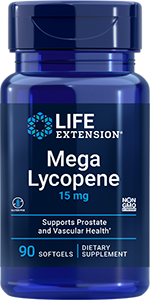
Lycopene is a carotenoid and the source of the red coloring of tomatoes, red peppers, red grapefruit, and watermelon. It may have the highest antioxidant properties of all the carotenoids. The powerful antioxidant action of lycopene helps to prevent the oxidation of serum lipids, thus promoting arterial health. Lycopene may also assist in maintaining cell-to-cell communication and modulating cytochrome p450 detoxification, factors that benefit susceptible tissue. Research has found that lycopene is better absorbed when preheated in, or co-ingested with fat. https://www.lifeextension.com/newshop/items/item00455.html
Vitamin E compounds are usually produced and made available in esterified form as alpha-tocopheryl acetate or alpha-tocopheryl succinate. Neither of these forms has any antioxidant activity until converted to alpha-tocopherol in the body, but they are much more stable with respect to storage time and temperature than the unesterified forms. Moreover, while the acetate form is rapidly activated within the body, activation of the succinate form is slower. The succinate form appears to access and benefit areas of the tissues that are unavailable to the other forms. For this reason, there is a tendency to regard alpha-tocopherol succinate as a distinctly different and beneficial compound. Alpha-tocopherol succinate appears to have longer half-life in the body, and does not interfere with vitamin A or K absorption. https://www.lifeextension.com/vitamins-supplements/item01863/super-vitamin-e | ||||||||||||||||||||||||
| ||||||||||||||||||||||||
| Questions? Comments? Send them to ddye@lifeextension.com or call 954 766 8433 extension 7716. For longer life, Dayna Dye Sign up for Life Extension Update at https://mycart.lifeextension.com/subscribe.asp Help spread the good news about living longer and healthier. Forward this email to a friend! View previous issues of Life Extension Update in the Newsletter Archive. | ||||||||||||||||||||||||