Newsletter
Newsletter
Tea polyphenols mechanism for halting prostate tumor growth and metastasis revealed
| ||||||||||||||||||||||||||||||||||||||||||
| ||||||||||||||||||||||||||||||||||||||||||
 | ||||||||||||||||||||||||||||||||||||||||||
| Life Extension Update Exclusive Tea polyphenols’ mechanism for halting prostate tumor growth and metastasis revealed Researchers from the University of Wisconsin and Case Western Reserve University in Cleveland, Ohio, supplied mice bred to develop prostate cancer with drinking water to which green tea polyphenols had been added over a twenty-four week period. A control group received water without any additives. The mice used in the study had been the subjects of previous research which found an inhibition in prostate cancer and development when the animals were give tea polyphenols. The current study found a decrease in insulin-like growth factor-1 ( (IGF-1) and an increase in insulin-like growth factor binding protein (IGFBP3) in the prostate glands of the mice who received green tea polyphenols, as well as inhibition of specific cell survival proteins. Elevations of IGF-1 and decreases in its binding protein have been found to be associated with cancer in this model as well as with an increased risk of some human cancers. The team also found that markers of metastasis were reduced. In addition, vascular endothelial growth factor, a polypeptide that forms new blood vessels, was lowered following treatment with green tea polyphenols. The formation of new blood vessels, or angiogenesis, is necessary for a tumor to receive nutrients and grow. Senior author Hasan Mukhtar, PhD, of the Department of Dermatology at the University of Wisconsin, stated, "These observations bear significance in light of studies that indicate increased levels of IGF-1 are associated with increased risk of several cancers, such as prostate, breast, lung and colon." The authors “suggest that IGF-I/IGFBP-3 signaling pathway is a prime pathway for green tea polyphenol-mediated inhibition of prostate cancer that limits the progression of cancer through inhibition of angiogenesis and metastasis.” | ||||||||||||||||||||||||||||||||||||||||||
| ||||||||||||||||||||||||||||||||||||||||||
| Protocol Prostate Cancer Adjuvant Therapy
Of these four factions EGCG is the most important to the PC patient. Pharmacological activity extends beyond its actions as an antioxidant and free radical scavenger. Epigallocatechin-3 gallate (EGCG) acts against urokinase, an enzyme often found in large amounts in human cancers (Jankun et al., Nature, 1997). Urokinase breaks down the basement membrane of cell junctions, which may be a key step in the process of tumor cell metastasis, as well as tumor growth (Ennis et al., Proc. Annu. Meet. Am. Assoc. Cancer Res., 1997). EGCG attaches to urokinase and prevents these actions. GTP also inhibits ornithine decarboxylase (ODC), resulting in a decrease in polyamine synthesis and cell growth (Carlin et al., J. Urol., 1996). Inhibitors of 5-alpha-reductase (5AR) may be effective in the treatment of 5-alpha-dihydrotestosterone-dependent abnormalities, such as benign prostate hyperplasia, PC, and certain skin diseases. The green tea catechins are potent inhibitors of type-1 but not type-2 5AR (Liao and Hiipakka, Biochem. Biophys. Res. Commun., 1995). They also inhibit accessory sex gland growth in rats. These results suggest the certain tea gallates can regulate androgen action in target organs. The 5AR inhibitor Proscar is predominantly a type-2 inhibitor. Long-term consumption of tea catechins is common in China and Japan. The frequency of the latent, localized type of PC does not vary significantly between Eastern and Western cultures, but the clinical incidence of metastatic PC is generally lower in Japan and other Asian countries, in contrast to the common occurrence of metastatic PC in Europe and the United States. | ||||||||||||||||||||||||||||||||||||||||||
| ||||||||||||||||||||||||||||||||||||||||||
What makes green tea extract such an important nutrient to supplement with are the large volumes of published scientific findings that validate its multiple biological benefits. The most significant studies show that green tea extract helps maintain cellular DNA and membrane structural integrity. The active constituents in green tea are powerful antioxidants called polyphenols (catechins) and flavonols. Several catechins are present in green tea and account for the bulk of favorable research reports. Epigallocatechin gallate (EGCG) is the most powerful of these catechins. The antioxidant activity of green tea EGCG is about 25-100 times more potent than vitamins C and E. One cup of green tea may provide 10-40 mg polyphenols and has antioxidant activity greater than a serving of broccoli, spinach, carrots or strawberries.
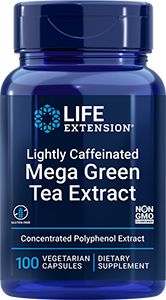
Mega Green Tea Extract Decaffeinated Research shows that green tea may help maintain the health of the arterial wall by reducing lipids while maintaining healthy platelet aggregation. There is also evidence from some studies that green tea provides immunoprotective qualities, particularly in the case of patients undergoing radiation or chemotherapy. White blood cell count appears to be maintained more effectively in patients consuming green tea compared to nonsupplemented patients. Green tea may also help maintain a healthy body weight. In one study, mice receiving green tea in their diets had a significant suppression of food intake, weight gain and fat tissue accumulation. Levels of cholesterol and triglycerides were lower in mice who received green tea. This study also showed that leptin levels decreased with green tea treatment, indicating that green tea may have a direct effect in reducing body weight. | ||||||||||||||||||||||||||||||||||||||||||
| ||||||||||||||||||||||||||||||||||||||||||
| December 2004 issue now online
| ||||||||||||||||||||||||||||||||||||||||||
| ||||||||||||||||||||||||||||||||||||||||||
| Questions? Comments? Send them to ddye@lifeextension.com or call 954 766 8433 extension 7716. For longer life, Dayna Dye Sign up for Life Extension Update at https://mycart.lifeextension.com/subscribe.asp Help spread the good news about living longer and healthier. Forward this email to a friend! View previous issues of Life Extension Update in the Newsletter Archive. | ||||||||||||||||||||||||||||||||||||||||||