Newsletter
Newsletter
Pomegranate extract slows lung tumor growth
 | ||||||||||||||||||||||||||||||
| ||||||||||||||||||||||||||||||
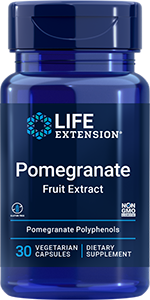
| Life Extension Update Exclusive Pomegranate extract slows lung tumor growth A report published in the April 1, 2007 issue of the journal Cancer Research described the finding of researchers at the University of Wisconsin-Madison that an extract of pomegranate fruit inhibited the growth of primary lung tumors in mice. Hasan Mukhtar, of the University of Wisconsin’s Medical Sciences Center’s department of dermatology, and his associates gave half of a group of 48 mice drinking water supplemented with 0.2 percent pomegranate fruit extract. The animals’ dose was selected to equate the amount of pomegranate juice that a typical human might be persuaded to consume (equal to the juice of two fruits). After a week of treatment, 12 of the mice that received pomegranate extract and 12 that did not were given a carcinogen known to induce lung tumors [benzo(a)pyrene suspended in cottonseed oil]. Twelve animals received cottonseed oil alone and served as controls. On the 84th day after administration of the carcinogen, mice treated with pomegranate had a 53.9 percent reduction in the number of their lung tumors compared with animals that received only the carcinogen. At 140 days, amount was 61.6 percent lower. In a similar experiment utilizing NTCU, a carcinogen known to induce lung squamous cell carcinoma, there was a 65.9 percent reduction in tumors among animals that received pomegranate extract 240 days after administration of the carcinogen compared with mice that received only NTCU. The researchers found that pomegranate inhibited the activation of nuclear factor kappa beta as well as influencing other factors. “Lung cancer is increasing worldwide,” the authors observed. “The development of alternative approaches, such as chemoprevention, is needed to control this epidemic in addition to continuing our efforts to strengthen the fundamental strategy of avoiding exposure to carcinogens.” “The present study suggests that pomegranate fruit extract inhibits lung tumorigenesis by targeting multiple signaling pathways and associated events and, therefore, strongly supports its development as chemopreventive agent against human lung cancer,” they conclude. Novel approaches are urgently needed that reverse, suppress, or prevent lung cancer development (van Zandwijk N 2005). Early detection offers the best chance for long-term survival (Saba NF et al 2005). The conventional choices of treatment include surgery, chemotherapy, and radiotherapy and depend on the type and stage of the cancer (European Lung Cancer Working Party 2006). Irrespective of the treatment method used, complementary therapy, such as nutritional supplementation and the use of bioresponse modifiers, is an important addition to traditional treatment that could help control symptoms, enhance quality of life, and improve overall survival (Jatoi A et al 2005b). Smokers, ex-smokers, and people who have never smoked should all consume five or more servings of colorful vegetables (including raw, darkly colored, and root vegetables) and fruits daily to achieve serum levels of micronutrients associated with the lowest risk of lung cancer. A diet rich in tomatoes, tomato-based products (containing lycopene), citrus fruits, and carotenoids (lutein, zeaxanthin, beta-cryptoxanthin, and retinol) reduces the risk of lung cancer (Holick CN et al 2002). Egg yolk is a bioavailable source of lutein and zeaxanthin (Johnson EJ 2002). Good food sources of carotenoids are spinach, kale, carrots, cantaloupes, cherries, and sweet potatoes. Phytoestrogens (plant estrogens) from food sources are associated with a decrease in the risk of lung cancer in both current smokers and people who never smoked, but less so in former smokers. Food phytoestrogens include isoflavones, phytosterols, and lignans. High intake of the lignans enterolactone and enterodiol and use of hormone therapy are associated with a 50 percent reduction in the risk of lung cancer (Schabath MB et al 2005). The soy isoflavone genistein significantly prevented lung tumor formation and cancer metastasis in mice (Menon LG et al 1998). Phytoestrogens are also available as nutritional supplements. https://www.lifeextension.com/protocols/cancer/lung_cancer_01.htm Featured Products
Food & Health Expo – Philadelphia, PA Life Extension is a sponsor of the 15th annual Food & Health Expo hosted by the Center for Advancement in Cancer Education on Sunday, April 15 from 9-6 at the Loews Hotel, 12th and Market Streets. This annual event honoring National Nutrition Month includes expert speakers, food prep demos, free food and beverage samples, a health book store, a live auction and over 50 exhibitors emphasizing the value of whole foods, whole food supplements and other healthy lifestyle tools. Presented in cooperation with the Mayor’s Office of Health and Fitness, the Expo features keynote speaker Dr. T. Colin Campbell, world famous nutrition researcher and author of The China Study. Special guest Christina Pirello, host and chef of Christina Cooks TV, will be among those providing food preparation demonstrations. Regular admission is $20 or $10 for students and seniors 65+. For tickets call 888-551-2223 or go to www.beatcancer.org/events.html | ||||||||||||||||||||||||||||||
| If you have questions or comments concerning this issue or past issues of Life Extension Update, send them to ddye@lifeextension.com or call 1-800-678-8989. For longer life,  Dayna Dye Sign up for Life Extension Update at https://mycart.lifeextension.com/Memberships/NewsSubscription.aspx Help spread the good news about living longer and healthier. Forward this email to a friend! View previous issues of Life Extension Update in the Newsletter Archive. | ||||||||||||||||||||||||||||||